Have you had any luck with the Perseid meteor shower? Some UK skywatchers were foiled by the weather, but many people here and around the world enjoyed stunning views. 1866 was also a good year for the Perseids. Alexander Herschel observed the shower from his family home at Collingwood in Kent. For several years, Herschel had been carrying out a regular programme of meteor observations, using a spectroscope to look for the characteristic signatures of different elements. As well as the Perseids, he observed the Leonids, Orionids […]
Last week one of our visitors asked us a question via Twitter while looking round our third-floor Flight gallery: Help me settle a debate @sciencemuseum, how did you get the planes in the flight exhibit into the building? Good question. First opened in 1963, the gallery was refurbished in the 1990s when a couple of new planes (including our Hawker jump-jet and a Hawker Siddeley executive jet) were added. To get the aircraft into the gallery, we took some windows out, built […]
It’s that time of year again, when the annual Perseid meteor shower lights up the skies. This year’s display promises a good blaze, weather permitting, as there’s no interfering moonlight. The meteor shower occurs as the Earth passes through debris from Comet Swift-Tuttle and meteoroids burn up in our atmosphere. It gets its name because the radiant, the point in the sky the ‘shooting stars’ seem to come from, is in the constellation of Perseus. Look for this near the […]
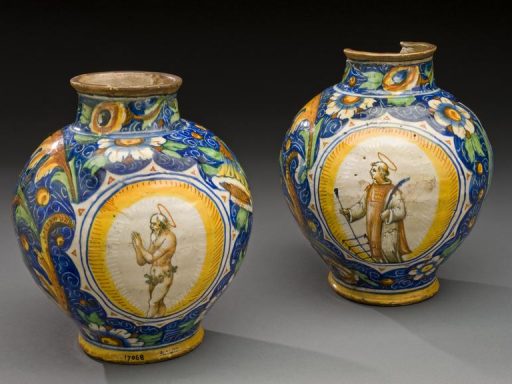
When you think of a medical collection, shelves packed with statues of saints aren’t the first thing that spring to mind, Selina Hurley, curator of medicine, tells us more.
In recent days, the aurora borealis, better known as the Northern Lights, have been visible at more southerly latitudes than usual thanks to solar storm activity. If you tried to have a look but were scuppered by the weather, or like us at the Science Museum you’re just too far south, enjoy these images of the aurora from our picture library instead. Of course, if you’re far south enough, you’ll be looking for the Southern Lights instead. The aurora australis […]
I visited Tate Britain last weekend to see a pair of fighter planes newly on show in the gallery’s central halls. Created by British artist Fiona Banner, Harrier and Jaguar sees a Sea Harrier suspended like a ‘captured bird’, according to the gallery, with a Jaguar nearby ‘belly up on the floor, its posture suggestive of a submissive animal’. It’s an arresting display. There’s nothing else. Just the two jets, one stripped bare, flipped over and defenceless, the other hanging menacingly as […]
Stories From The Stores is one year old today. Woo hoo! Over the past twelve months, we’ve told 200 stories about science, technology, engineering and medicine as captured in our remarkable collections of objects, pictures, books and archives. Our history – your history and mine – is embedded in the objects we’ve invented, made and used. Time flies, and we might forget this history if we didn’t collect stuff. Here, for instance, is a state-of-the-art aircraft flight exactly a century […]
Its a worrying title for a blog, but ‘remember that you must die’ or ‘memento mori’ in Latin, was a common saying that our historical counterparts took to heart. Popular from the 16th to the 19th centuries, memento moris can can be anything from pocket watches, pendants, rings, ribbon slides, even statues and walking sticks. Some carried a lock of hair from a departed loved one, woven into a scene. Most show skeletons, skulls or coffins and – not for […]
Monday marked 401 years since Thomas Harriot made the first recorded astronomical observation with a telescope – so one year since we opened our Cosmos & Culture exhibition celebrating Harriot and other astronomers. For the last year, we’ve been lucky enough to have some of Harriot’s drawings on display, but for their long-term preservation it’s time to remove them from the light. This weekend is your last chance to see the centuries-old originals before we return them to their owner’s care and replace them […]
This box contains a flight spare set of experimental surfaces for the Prospero satellite that was launched in 1971. They were designed to tell scientists more about how different satellite materials and finishes – matt, shiny etc, would behave in the temperature extremes of space. It has always reminded me of a much larger experiment flown by NASA (LDEF – which stands for Long Duration Exposure Facility) that was covered with all sorts of equivalent surfaces. The LDEF was brought […]
Magnified bee from George Adams’ Essays on the Microscope, 1787 (Science Museum).
I wonder if the RIBA (Royal Institute of British Architects) had a little-known sub-section devoted to pigeon fanciers. A branch, perhaps (or a wing)? How else to explain the preponderance of interesting features high up on old buildings that are indistinct at street level but – presumably – clear as bread crumbs to passing pigeons? I was mulling this over yesterday as I squinted at the figures and details of The Treasury’s Whitehall pediment, and then again while attempting to make out the features […]