Recently, one of my colleagues sent me this link to a small synthesizer hidden in a book. The synthesiser is a bought piece of equipment, but it’s designed to be hacked and modified by whoever uses it and this particular owner probably had a good reason to keep it hidden. Or he just thought it would be fun to stick a synth in an old book. Either way, this quirky instrument instantly reminded me of one of the objects in […]
Our world-class collection forms an enduring record of scientific, technological and medical achievements from across the globe. Come behind the scenes as we explore new object acquisitions and meet the conservation team.
100 years ago today, Marie Curie was awarded the Nobel Prize in Chemistry, becoming the first person to win two Nobel Prizes. The citation recognised ‘the discovery of the elements radium and polonium … the isolation of radium and the study of the nature and compounds of this remarkable element’. Isolating radium from pitchblende was a laborious process, with a ton of ore yielding only a tenth of a gram of the new substance. In the early 20th century radium […]
It’s November, which means that some of your friends may sprout some dubious facial hair over the next few weeks. Yes, it’s that time of year again when thousands of blokes bid goodbye to their razors and grow a moustache to raise awareness for men’s health issues. For anyone unsure which style to adopt, there’s plenty of inspiration to be found in the Science Museum. The most famous scientific moustache is of course Albert Einstein’s, which has spawned some truly […]
This is undoubtedly our most famous painting: Philip J. de Loutherbourg’s 1801 ‘Coalbrookdale by Night’, a noisome depiction of the industrial revolution in all its terrible glory. Here are the ‘Bedlam furnaces’ in action – open coke hearths used for smelting iron, the visible face of a burgeoning coal industry. But if we dig a little deeper, we find a rich and little-known iconographic seam in the Science Museum’s art collection. For one thing, what de Loutherbourg saw at Coalbrookdale was […]
Have you ever noticed on exhibition labels, the small, sometimes non-sensical number that follows the blurb about an object? These numbers are vital to help us find out what the object is and locate it on our database. With a collection of over 200,000 objects, on three different sites and around 95% in storage we certainly need all the help we can get. When objects arrive at the museum they are assigned a temporary number. Many different systems have been used […]
Are you annoyed by cartons that don’t pour properly or people talking too loudly on public transport? Well now’s your chance to share an everyday irritation with our inventor in residence, Mark Champkins.
In the Wellcome medical collections, there are lots of relics relating to famous people, some of which have featured on this blog. Many of them are from the great men of medicine and science, Joseph Lister, Louis Pasteur, as well as military and naval men, Nelson, Napoleon and Wellington. In the Wellcome Library, only one woman’s name made the inscription in the Reading Room: Florence Nightingale. Not so with the collections though. During one visit to the stores I came across […]
Astronomers have announced that they can now track sunspots forming before the tell-tale dark spots reach the Sun’s surface. The spots are caused by magnetic activity inside the Sun, and are associated with solar storms, massive bursts of material coming from our star. NASA recently released these staggering observations of our little blue planet being swamped by a sunstorm. Better prediction of solar storms is vital to protect our communication, navigation and power systems. In 1859 the biggest solar storm on record zapped […]
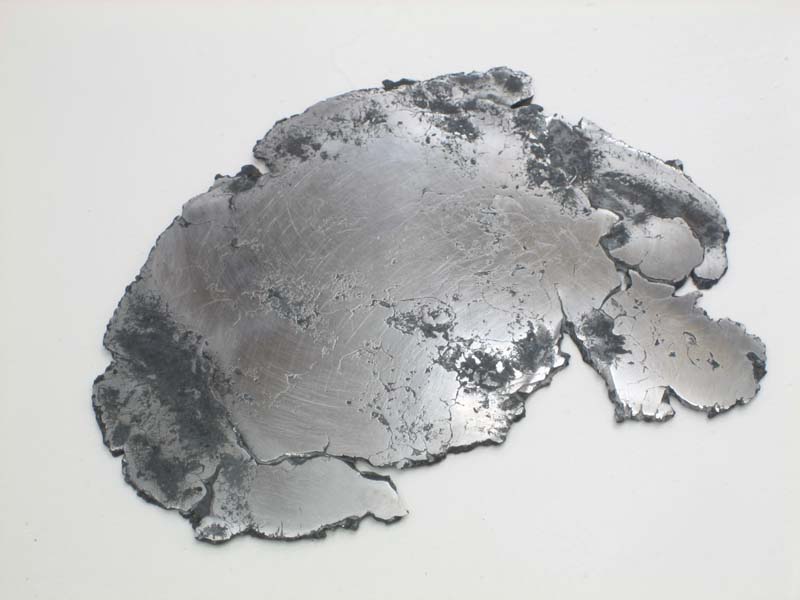
Artworks, made from meteorites that landed on Earth 6,000 years ago, are on show in the Science Museum until 30 October 2011
Our curator Doug Millard tells us about the time he journeyed from SW7 London to Houston Texas to collect a piece of the Moon.
Today would have been the 15th birthday of the first cloned mammal, Dolly the sheep. Named after the singer Dolly Parton, Dolly caused quite a storm when the news first broke of her birth. In September 1997, a competition called ‘Do a Design for Dolly’ was launched by the Cystic Fibrosis Trust and supported by Portman Building Society. In March the following year, a 12-year-old girl, Holly Wharton, was announced as the winner. Her design was made from Dolly’s wool […]
Behind every Museum object there can be dozens of stories about the people who made and used it, or are otherwise linked to it. In an upcoming exhibition about the relevance of our collections to family historians we’re going to use one object to illustrate that fact – and we’re hoping that you might be able to help us out. We’re going to take this doctor’s bag and unpack some of the personal histories that are connected to it. It […]