This artice was written by Ellie West-Thomas, Research Assistant for Electronic Music Fourteen years ago the BBC Radiophonic Workshop, who created innovative music and techniques that made it one of the most significant influences on electronic music today, closed its doors for the last time. Maida Vale Studios, the home to the workshop, was a place once filled by people brimming with ideas that changed the course of Electronic Music. The Workshop was set up to satisfy the growing demand in the late 1950s […]
Our world-class collection forms an enduring record of scientific, technological and medical achievements from across the globe. Come behind the scenes as we explore new object acquisitions and meet the conservation team.
The Science Museum is very pleased to announce our first ever Sound Artist in Residence, Aleks Kolkowski. In recent years Aleks has explored the potential of historical sound recording and reproduction technology to make contemporary mechanical-acoustic music. His works for singers, instrumentalists and even singing canaries often feature live-made sound inscriptions onto wax cylinders and lacquer discs using Edison phonographs and old disc recording lathes. Other activities include repurposing discarded digital CDs with 45rpm analog records and both sound installations […]
Here’s our next installment in the addictive history of medicine… Medicinal preparations of opium are usually associated with the Victorians, but their origins are much more ancient. References to poppy juice are mentioned on 7th century BC medical tablets from the Assyrian civilizations, and the Sumerians called the poppy the ‘plant of joy’. The Greeks used poppy preparations widely in their medicine, although most famously in the mixture called Theriac or Mithrate which was invented in the 1st century AD. […]
This article was written by Bruce Eadie, intern on the Family History project. You wouldn’t happen to be called Bushby would you? Well, down at the Science Museum we know something about your great-great grandfather that you might like to know. With the huge and growing popularity of genealogy, the Science Museum is keen to make its collections and archives available to family historians. Many family historians begin by hearing family stories told by older relatives, by leafing through […]
If you’ve ever been in hospital, there’s a good chance your doctor gave you morphine to help with the pain when recovering from a procedure. If you have ever had a bad cough, you might have been given a cough syrup with codeine in it. We don’t usually think of addictive substances as playing an important role in medicine, but the Science Museum’s pharmaceutical collection shows that these drugs have been widely used by doctors since ancient times. Opium in […]
This article was written by Ellie West-Thomas, Research Assistant for Electronic Music. Whilst exploring the Science Museum’s Stores at Blythe House, I came across something rather unusual. Being classically trained in music and music theory I have had to write a score and use musical notations on many occasions, but I never knew that a typewriter could be used to write sheet music. The Musicgraph or Musikriter, was invented by Lily Pavey, patented in 1961 and completed in 1963. Pavey was the […]
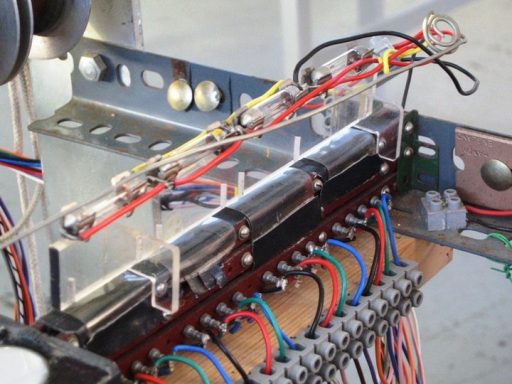
On 10 October 2011, the Science Museum opened the exhibition Oramics to Electronica: Revealing Histories of Electronic Music.
Fifty year ago today, the Royal College of Physicians published a report on the effects of smoking which clearly linked the habit to cancer, bronchitis and other health problems. Although it came several years after the ground-breaking research by Richard Doll and Austin Bradford Hill which first raised the issue, it was this report which really marked a major shift in British attitudes towards smoking. Change was not instantaneous, but in 1965 cigarette advertising had been banned on TV and […]
The 29th of February, a Leap day, is coming up again. On this mysterious date 20- year- olds celebrate their fifth birthdays and so on. What has this got to do with this beautiful armilliary sphere , on display in The Science Museum, London? Armiliary sphere by Sisson (credit: Science Museum) The sphere was made in 1731 for Prince Frederick , son of George II, who died before his father, hence he never came to the throne. Both he and Princess Augusta were […]
Tape-players and tape-recorders were perhaps the most important instruments for many of electronic music’s pioneers, and for the staff of the BBC Radiophonic Workshop in particular. With few electronic instruments existing, early sonic explorers were forced to adapt and abuse existing technologies, and practices such as tape-splicing soon became vital tools in the search for new sounds. Since then, the situation has changed dramatically for most musicians and electronic instruments and equipment have become ever more accessible and affordable. Or […]
Like most curators, I’m always on the look-out for interesting stories and things that capture public interest. So it won’t be much of a surprise to find I’ve been watching and reading Call the Midwife by Jennifer Worth. Call the Midwife chronicles the work of the author as a midwife in the East End of London in the 1950s. As you would expect we have a large collection of objects relating to midwifery and obstetrics. The piece of kit that caught […]
Last time we looked at a curious fire-powered organ invented by Strasbourg’s Fréderic Kastner in 1873. The instrument wasn’t a great success, but Kastner’s family connections brought it a certain amount of acknowledgement. While he “was not a distinguished physicist …he had a rich and influential mother who, it has been said, encouraged him in the development of the pyrophone in order to provide him with an occupation that would keep him out of mischief”. Amongst Mme Kastner’s acquaintances was […]