Amongst our peerless collection of artificial limbs are a number which have been designed or adapted for very specific functions. For example, the special attachment that allowed a one-armed WW2 bomber pilot to hold the joystick in his plane or the artificial leg terminating in a hollow metal half-sphere that prevented a keen beachcomber from sinking into the sand. The arm pictured above is one of the most intriguing examples we have. Acquired from Queen Mary’s Hospital in Roehampton, it’s […]
Our world-class collection forms an enduring record of scientific, technological and medical achievements from across the globe. Come behind the scenes as we explore new object acquisitions and meet the conservation team.
Sir Henry Bessemer’s motto summed him up – one who strived, faced and overcame obstacles to achieve a number of successes. These culminated in the invention of his process for the bulk production of steel in 1856. This development was to prove massively significant in the extension of the railways and in large construction. Bessemer, born 200 years ago this month, sought the key process that would allow him to live in the lap of luxury. His father, Anthony Bessemer, also […]
This blog post was written by Johanna Stevens-Yule Luigi Galvani and Alessandro Volta both made names for themselves with their pioneering work on electricity—however; electricity would prove to be the destructive force to the majority of their actual instruments. Here at the Science Museum we find ourselves in the position of owning Galvani’s very own electrostatic machine, but this so very easily might not have been the case. Unlike several other pieces of Galvani’s equipment, it escaped being destroyed in […]
This blog post was written by Pippa Murray Today marks the 150th anniversary of the opening of the London Underground – arguably one of London’s most iconic landmarks. Of course back in 1863, when the first tube line opened, the map looked remarkably different from the one we know today with only the metropolitan line running between Paddington and then onto Farringdon Street (a stretch measuring only six kilometers). Yet as the network of tunnels evolved throughout the late 19th […]
Everyone, at some point in their lives, will ‘accidently’ ingest something that, well, they really shouldn’t have. At best, the event might provide an amusing story to tell your friends, at worst the consequences can be serious enough to make the news. Of course, the deliberate ingestion of foreign bodies into the human body can be symptomatic of serious mental health issues. A compulsive urge that can result in real physical harm. Hidden within our medical collections are examples of […]
Something a bit different from Stories from the Stores today – we’re hosting the History Carnival, and bringing you a roundup of last month’s blogs on history (and a few other links we just found interesting). Don’t worry – in true STFS style, we’re still illustrating it with objects and images from the Science Museum’s collections! Slaughter, Shakespeare and squibs November’s remembered for gunpowder treason and plot, for which Guy Fawkes suffered a traitor’s execution: hung, drawn and quartered. As Kathleen McIlvenna points […]
This post was written by Tara Knights, a work placement student with the Research & Public History department from Sussex University’s MA Art History and Museum Curating. These days most of us have a camera the size of our mobile phone. We can effortlessly take pictures of anything and everything, but what role did photography play in the lives of our ancestors? In this second of a series of blog posts, we will continue to explore the lives of our […]
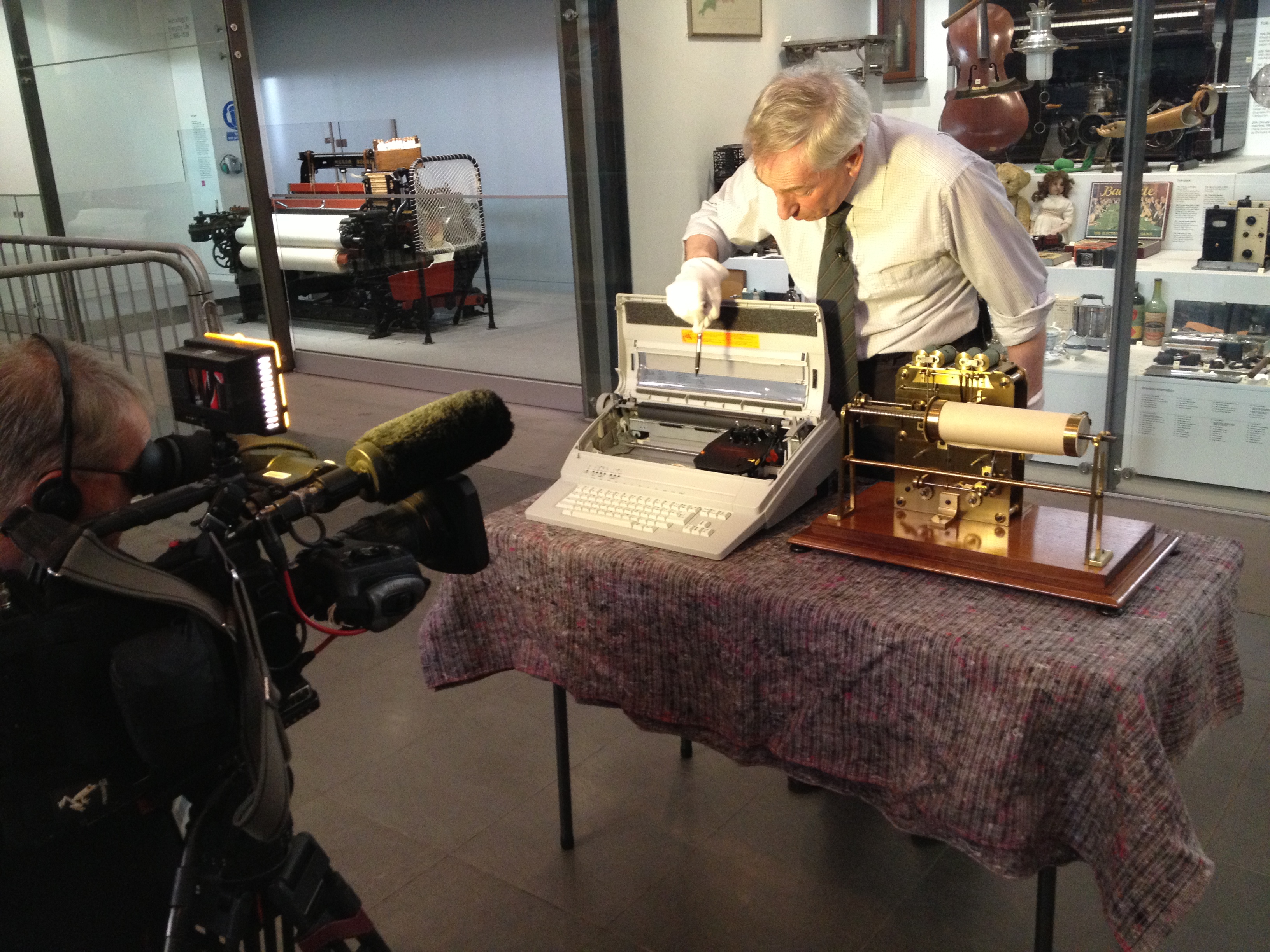
Clack clack clack clack… ping! The sound of a typewriter sweeping across the page, already becoming a faint memory, will soon fall silent as the mass manufacturing of this technology ends in the UK.
Phew..! Finally the moment you’ve all been waiting for: the resolution to last week’s incredibly dramatic cliff-hanger ending! Here’s the second part of our interview with electronic musician, circuit bender and all-round nice guy Andy Wheddon: Click here to listen to the podcast. Guest blog post from Robert Sommerlad, a musician and Science Museum research assistant.
Collecting stuff is generally the bit I like most about my job. That’s probably why I’ve got a bit over excited about the new acquisitions we’ve made related to synthetic biology – from no other than Tom Knight widely described as the “father” of the discipline. Synthetic biology is research that combines biology and engineering. Sounds like genetic engineering by another name? Well yes, but it goes much further. It looks to create new biological functions not found in nature, […]
At around 1.15 pm, on 21st October 1805, a small projectile (shown in the above engraving), fired at a range of about 50ft, passed into Admiral Horatio Nelson’s left shoulder and, ricocheting against bone, tore a path through his upper body before passing into his lower back. The musket ball took with it fragments of the his coat and its epaulette which remained attached after it came to rest. Nelson died a few hours later as the Battle of Trafalgar drew […]
This post was written by Emily Yates, object conservator at Blythe House As a conservator, it is always fun to work on weird objects, even the gory ones! This beautiful, if macabre, wax model will be on shown in the exhibition Doctors, Dissection and Resurrection Men at the Museum of London, running 19 October 2012 until 14 April 2013. To get her looking her best before going on show I had to remove the layers of dust and dirt that had built […]