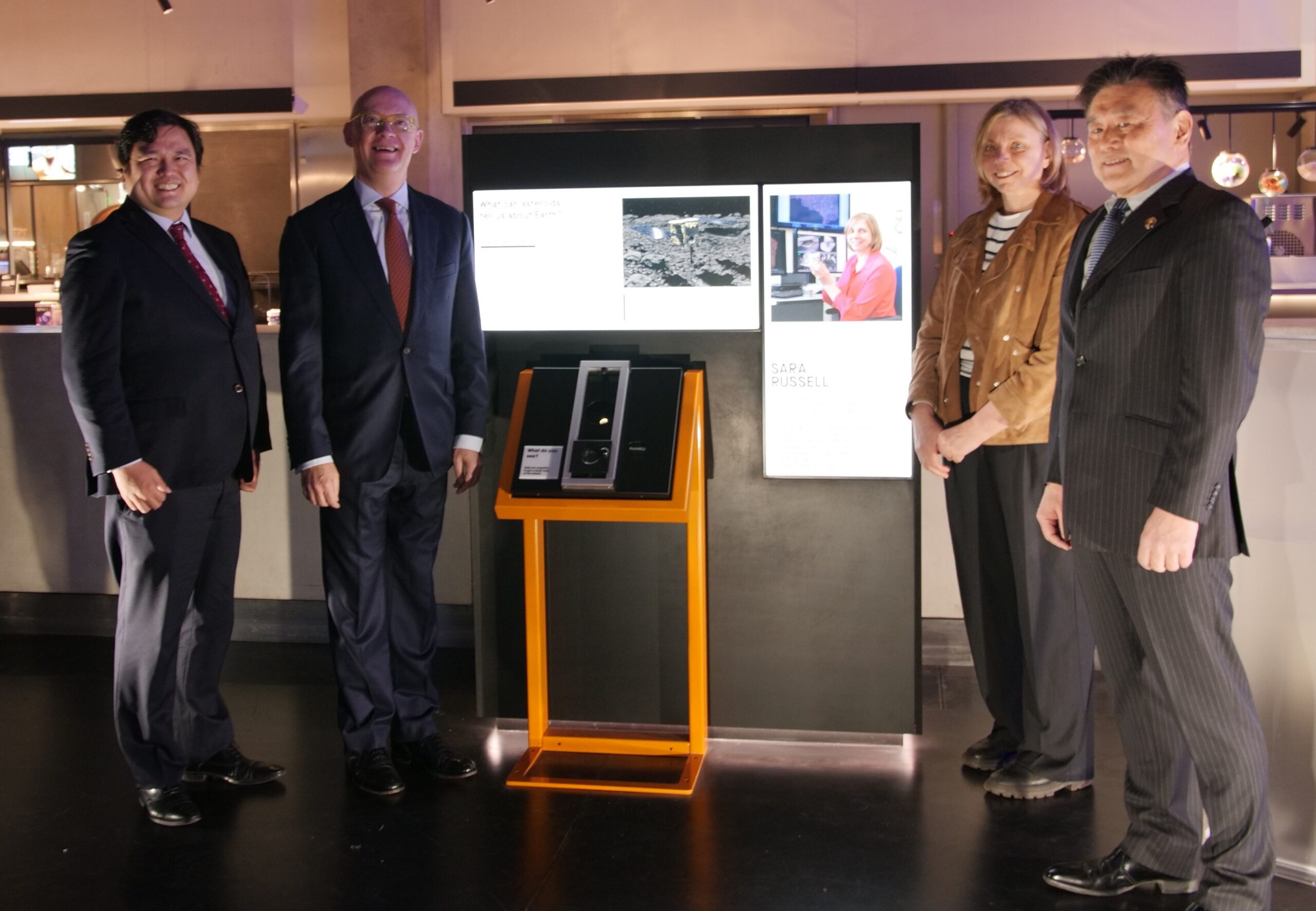
Within a new display in the Science Museum sits a grain of rock so small you might walk past it without a second glance. But this grain is one of the most consequential objects on Earth.
The fragment came from an asteroid named Ryugu (pictured below), a diamond-shaped rock roughly 900 metres across that orbits the Sun on a path looping just inside Earth’s orbit and just outside that of Mars, and is part of an effort to understand the origins of solar systems, indeed life itself.

Ryugu is a time capsule: its composition has changed little since our Solar system coalesced some 4.6 billion years ago from a slowly rotating cloud of interstellar gas and dust.
A ‘protoplanetary disk’ – seeded with heavy elements forged in the cores of long-dead stars – began to collapse under its own gravity, concentrating most of its mass into what would become the Sun. The remainder flattened into a spinning protoplanetary disk where planets grew, leaving asteroids as the leftovers.
The museum’s Ryugu grain, which measures between 2.1 and 1.7 millimetres, was studied with X-ray Computed Tomography (XCT), where two-dimensional X-ray images are taken from different angles to build up a three-dimensional picture (which can be seen below).
In the Ryugu samples, scientists found a drop of water, containing salts and organic matter, and this month announced in the journal Nature Astronomy they had also discovered all five fundamental ‘letters’ – adenine (A), guanine (G), cytosine (C), thymine (T), and uracil (U) – of the genetic codes DNA and RNA.
As Prof Fujimoto put it, because ‘habitability is a key word’, this is a ‘tiny grain with a big message about the early days of the Solar System.’
The Journey Home
Prof Fujimoto told a science seminar in the museum how Hayabusa2 was one of the agency’s ‘small and smart missions’. Launched in December 2014, the robotic spacecraft travelled billions of kilometres to reach the ‘primordial asteroid’ Ryugu, in June 2018, where it spent eighteen months surveying the terrain with the help of hopping rovers, probing and sampling.
In February 2019, the spacecraft briefly touched down and fired a tantalum projectile into the surface, funnelling the resulting debris into a horn; seven weeks later, it released a separate free-flying device that detonated to drive a two-kilogram copper slug into Ryugu, blasting a crater and exposing material untouched by billions of years of solar radiation (neither copper or tantalum occur naturally on Ryugu, making any contamination easy to identify).
On 5 December 2020 the mission returned its sample capsule to Earth, landing in Woomera, the outback in south Australia, no mean feat given they were ‘importing something weird from space’ mid pandemic, he said.
He described how, within the protoplanetary disk is the snow line, a boundary beyond which the temperature is low enough to encourage the formation of sticky ice, one reason that gas giants like Jupiter form first.
But, of course, that leaves a mystery: what brought water to rocky planets like Earth that formed within the snow line and are ‘born dry’? Ryugu’s parent body formed in the freezing outer solar system before migrating inward, importing water and the organic building blocks of life. Ryugu-like asteroids may have supplied Earth with the chemicals for a living planet to evolve.
JAXA will this year launch the MMX mission which will land on the Martian moon Phobos, which scientists believe to be an asteroid captured by Mars’ gravity. The aim is to return a sample from Phobos to Earth in 2031. ‘We will be the first to make a return trip to the Martian system,’ he said.
And JAXA plans to join Ramses, ESA’s mission to rendezvous with the 375 m asteroid Apophis and accompany it through its safe but exceptionally close flyby of Earth in 2029. He told the unveiling ceremony it was too good an opportunity to miss, not least for honing planetary defences.
Watching a thousand skies
If a life-giving water and organic molecule delivery mechanism operated on Earth, did the same events unfold on planets orbiting other stars? Enter the Atmospheric Remote-sensing Infrared Exoplanet Large-survey, ARIEL a mission of the European Space Agency under construction with the help of hundreds of scientists and engineers from 17 countries, including principal investigator Prof Giovanna Tinetti of KCL.
Airbus in Toulouse, France, is in overall charge of building Ariel, and will be using its Stevenage, UK, facility too, while its mirror and instruments will be assembled and tested at RAL Space on the Harwell Campus in Oxfordshire.
ARIEL will not hunt for new planets orbiting alien stars; since the 1990s more than 6000 exoplanets have already been found by missions like NASA’s Kepler and TESS. Instead, ARIEL will work out what those planets are made of, even though they are too distant to visit.
The telescope will observe planets as they transit their host stars, Prof Tinetti told a space science seminar hosted at the museum. During these transits, starlight filters through the planets’ atmospheres. By spreading that light into a spectrum, ARIEL’s instruments can identify the chemical fingerprints of water vapour, carbon dioxide, methane, and more. ‘Molecules have a specific way of absorbing and transmitting light, so you can work out what is present in an exoplanet far way,’ she said.
From rocky super-Earths to bloated gas giants, the mission aims to survey around a thousand planets – producing the first large-scale chemical census of exoplanet atmospheres. The launch date has slipped from 2029 to 2031, when it will be parked in a stable point 1.5 million kilometres from Earth.
This ‘zoo of planets’ seen so far can be as strange as seen in Hollywood movies, she said. Some orbit their parent star in less than a day. Others have molten rocks, or orbit more than one star, as seen in Star Wars. Or there are water worlds, as glimpsed on Interstellar.
‘Over the next decade we will understand if our Solar System is rare or not’, said Prof Tinetti, though she added that most rocky planets found so far between the equivalent orbits of Earth and Neptune are mega Earths, at least ten times the mass of our own.
Already the Atacama Large Millimeter/submillimeter Array (ALMA), an international radio telescope in Chile has revealed the debris around newly born stars as dust rings, gaps, cavities, and crescents in high-resolution observations of what are called protoplanetary discs. ‘It is a nursery of structure – the rings in the discs might signal planet formation,’ she said.
A Grain of Meaning
The menagerie of known exoplanets has already upended expectations: hot Jupiters that orbit their stars in days, not years; compact multi-planet systems that pack more worlds into a small orbit around a dim star than our solar system fits into its inner zone.
Complementing these observations are attempts to model how new worlds assemble in mathematical form, from the long range pull of gravity to short range electrical forces, then run simulations on a supercomputer to provide a deeper understanding of what paved the way for our own Solar System, along with the emergence of life on Earth 3.8 billion years ago.
Probing these questions last month earned one scientist a major prize. Dr Paola Pinilla, a physicist at UCL’s Mullard Space Science Laboratory, has been named a laureate in the 2026 Blavatnik Awards for Young Scientists in the UK.
The core problem she addresses is deceptively simple. In a smooth, uniform disc of gas and dust around a young rotating star, particles of dust drift steadily inward and are lost before they can clump together into anything planet-sized. Something must be stopping that drift.
Pinilla’s research has identified pressure bumps which, though their origins are mysterious, seem to seed planet formation in a way that is akin to how drops of rain form in clouds around microscopic particles. The bumps act like natural harbours, trapping dust particles long enough for them to accumulate, collide, and eventually grow into ‘the embryos of planets.’
While one set of models looks at how minute dust grains and gas interact early on, another focuses on how gravity takes over when they have grown into rocky lumps and clumps, along with the role of ‘sticky’ ice and water beyond the snow line, which triggered the growth of Jupiter, ‘the first planet of our Solar System to form.’
Her most recent models also examine how these traps control the flow of pebbles and volatile materials into the inner disc – determining the type of material available for forming rocky, potentially habitable planets. ‘We predicted how these pressure bands will look at different wavelengths – they will look like ring-like structures, and that is exactly what you can see.’
Importantly, when it comes to life, ‘a pressure trap can really change the abundance of water that we see in the inner parts of the disk, like the first astronomical unit where the Earth is located.’
Like Profs Fujimoto and Tinetti, Dr Pinilla is looking forward to using ARIEL data, in her case to see how the location of gas giants affects the distribution of water in embryonic solar systems. In this way, a grain of primordial rock, pressure bumps and a thousand distant skies will use three different approaches to probe the mystery of our origins.