In December 1968 I was watching the Apollo 8 mission with Mum and Dad on our old black and white television set. The three astronauts circling the Moon were Frank Borman, Jim Lovell and Bill Anders. The pictures beamed to Earth were indistinct, but it was the audio I recall clearly. On Christmas Eve, Anders announced the crew had a message for everyone on Earth. They then took turns to read passages from the Bible. Frank Borman, mission commander, signed off, “And from the crew of Apollo 8, we close, with good night, good luck, a Merry Christmas, and God bless all of you, all of you on the good Earth.”
I remember those words vividly.
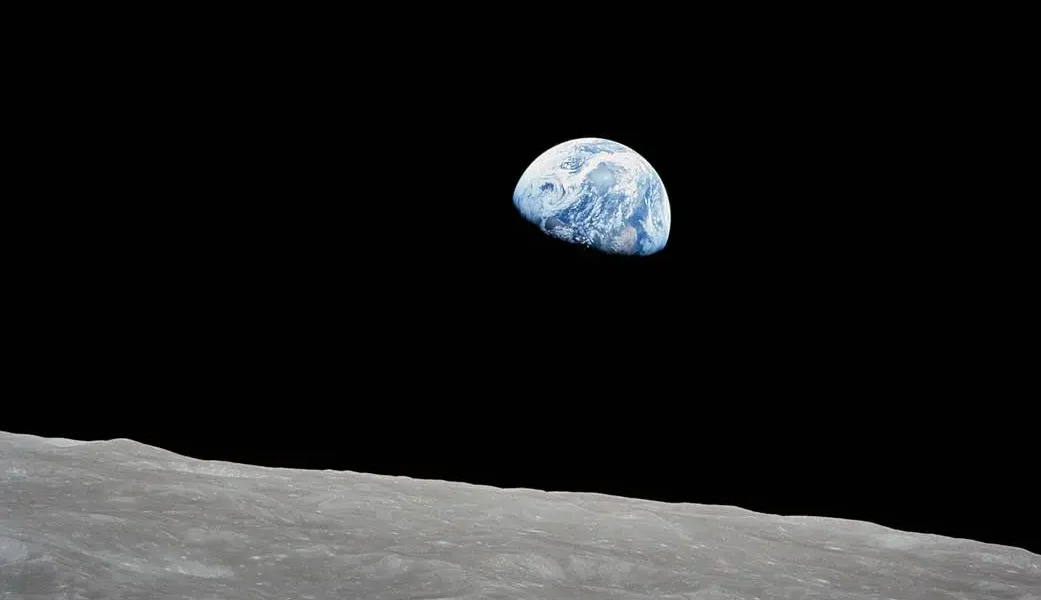
As famously, when their spacecraft was coming around the Moon, Anders suddenly said, “Oh my God! Look at that picture over there. There’s the Earth coming up. Wow, that’s pretty”.
A few days later the first colour pictures of what Anders had seen and then photographed started to appear on the front covers of magazines. My brother bought one home. That was when the power of the first ‘Earth Rise’ picture, as it came to be known, hit home.
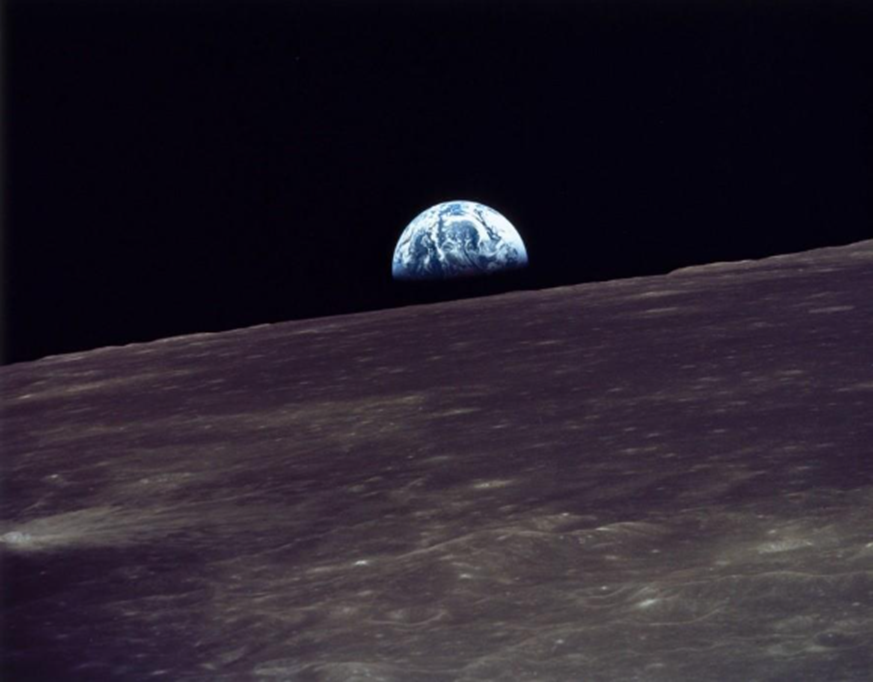
For the first time we were able to look upon our beautiful world from deep space. Here was our planet, alone but radiant in the inky blackness of space.
Will the Artemis 2 pictures of Earth from even further out in space have the same impact? The Apollo and Artemis missions – separated by five decades – have similarities, but plenty of fundamental differences.
Apollo 8 was the first space mission to take human beings to another world. Eight more Apollo crews made that same journey. Six landed on the Moon. Artemis 2 will be the ninth and while it will go way beyond the Moon, it will not orbit the Moon like Apollo 8 did. That mission circled the Moon ten times with Anders taking the first pictures of the Earth ‘rising’ from behind the Moon on the first orbit.
Apollo 8 was a quick fix mission. It should have been testing the Apollo lunar module, the lander that would be used to eventually touch down on the Moon, in Earth orbit. But it wasn’t ready. NASA was also increasingly worried that the Soviet Union was about to launch a space spectacular to the Moon.
So, the US agency decided to go ahead and send humans in the proven command module – the main Apollo spacecraft – into orbits of the Moon and then back to Earth.
It was a gamble. Humans had never ridden the massive Apollo Saturn V rocket before. But the gamble paid off. All went near perfectly and NASA had the headlines confirming they had reached the Moon first.
The US had turbo-charged its lunar programme and struck a major blow against the Soviets. Cosmonaut Alexey Leonov later told me that when the Apollo 8 completed its historic mission he and the rest of the Soviet space team knew they had lost the race to land on the Moon.
The Apollo lunar module was ready for testing on the next mission, Apollo 9, and just two months later in May 1969 Apollo 10 tested both spacecraft while orbiting the Moon. Two months later Neil Armstrong stepped onto the lunar surface from the lunar module of Apollo 11.
Fast forward to Artemis II and its lander is still many months, possibly years, away from being ready. Apollo’s was only a few weeks late when NASA Administrator James Webb took the decision to send Apollo 8 towards the Moon without it.
Artemis II will not orbit the Moon, like Apollo 8 did, but fly past and then back to Earth on a huge loop. With many new Artemis systems still to be tested in flight it is safer to do this using something called a free-flight trajectory. Once the spacecraft is aimed towards the Moon and then sailed past it the Moon’s and Earth’s gravities will pull it back to Earth.
Apollo 8 was a step along the way to fulfilling President Kennedy’s commitment to land a man on the Moon and bringing him safely back to Earth before the end of the 1960s. Setting a deadline was an implicit challenge to the Soviet Union. The Soviets didn’t engage with Kennedy’s dare at first but, once it was clear the US was serious, they made their own, secret plans to do so. A race was on.
The Artemis programme is a little different. It is less a race, more a marathon. With international partners like the European Space Agency, NASA intends to return to the Moon, this time to stay. It means to establish a permanent human presence there – a lunar base. Ultimately, all the experiences and expertise developed with the Artemis programme will be channelled towards a human mission to Mars.
The Artemis II pictures will be powerful. Like those taken at the Moon by Apollo 8’s Anders they will resonate around the world. But this time the Moon will fill the view with the blue Earth beyond appearing far smaller.
Apollo 8’s Earth Rise fed the fast-evolving environmental movement on Earth. Anders later said, “We came all this way to explore the Moon, and the most important thing is that we discovered the Earth”. Perhaps Artemis II will let us rediscover the Earth all over again.