Artificial intelligence is often billed as the solution to every problem, where researchers in diverse fields, from materials science to climate modelling, are urged to use machine learning, when AI is trained on lots of data to make predictions.
Yet AI rests on many assumptions and has a basic flaw: it struggles with chaos. The weather, turbulence, and fluid flowing rapidly through a pipe are all examples of chaotic systems. By that, scientists mean that tiny differences in starting conditions – the butterfly effect – can make the outcomes of predictions about how they will behave wildly different. Train an AI on such systems, and it can soon drift into nonsense.
Now a team at the Centre for Computational Science, University College London has demonstrated how AI can handle chaos with the help of a quantum computer, which harnesses the strange rules of quantum mechanics to explore many possible solutions at once, solving in moments certain problems that would take traditional ‘classical’ machines millennia to crack.
The quantum computer does not replace AI but, as the team describes in the latest issue of the journal Science Advances, teaches the AI something a traditional ‘classical’ computer cannot easily learn on its own.
The team, including Maida Wang, Dr Xiao Xue, Mingyang Gao, and Prof Peter Coveney used what they call Quantum-Informed Machine Learning (QIML), which boosts the ability of AI, which sometimes guesses patterns that look plausible but break the laws of physics.
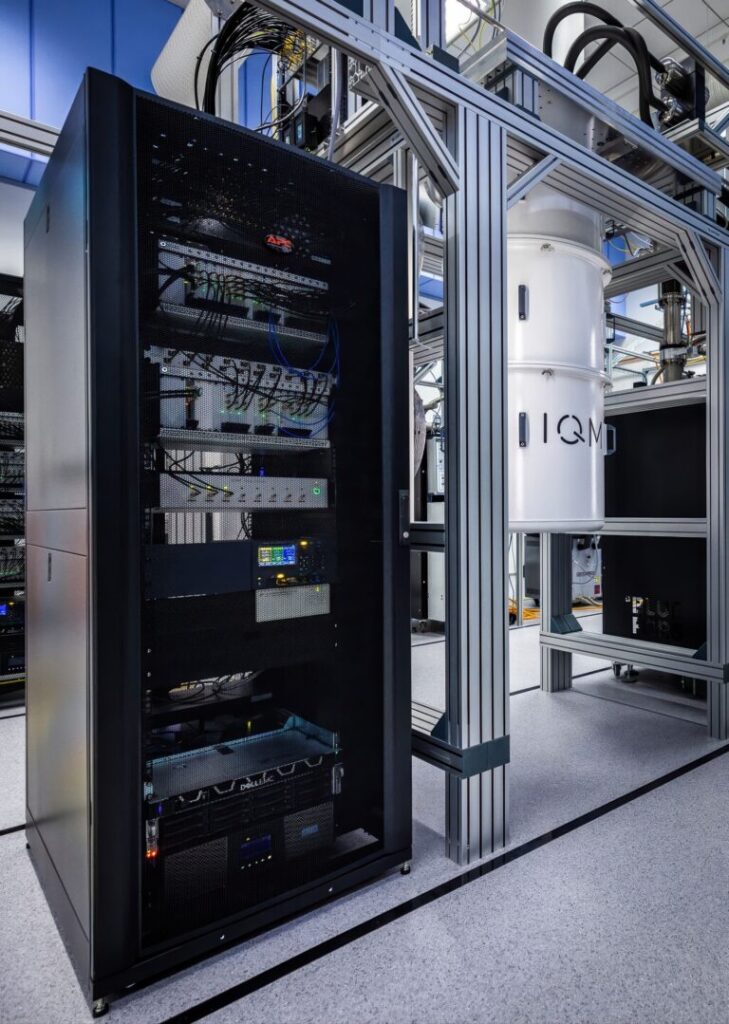
Quantum computing is used to constrain AI, so its predictions obey the laws of nature in two steps: First, a quantum computer made by the Finnish-German company IQM Quantum Computers was trained once on a dataset describing a chaotic system, whether the weather, the behaviour of a double pendulum or a dripping tap. The quantum computer then produced a compressed ‘summary’ of the data’s underlying patterns, a Quantum Prior, or Q-Prior, and this ‘physics cheat sheet’ was used by the AI to make predictions.
Joint first author, Maida Wang, remarked: ‘When predicting severe weather or designing aircraft, you cannot afford an AI that drifts away from reality. By anchoring the AI with what we call a quantum prior, which you can think of as a map to help navigate unfamiliar terrain, we force it to remain physically honest.’
Quantum computers already exist however they are limited and, moreover, moving data back and forth between quantum and classical computers is slow and error-prone. By comparison, the quantum step in the new approach is a one-off investment, helping to teach AI the laws of physics by shrinking megabytes of data into a tiny, kilobyte-scale summary, the Q-Prior.
The reason it is important to augment AI this way is that quantum circuits can represent many possibilities at once, allowing patterns to be captured more efficiently so it is possible to spot long-range connections that a classical AI would need vastly more data to learn. This allowed the team to capture subtle relationships in chaotic systems using fewer parameters.
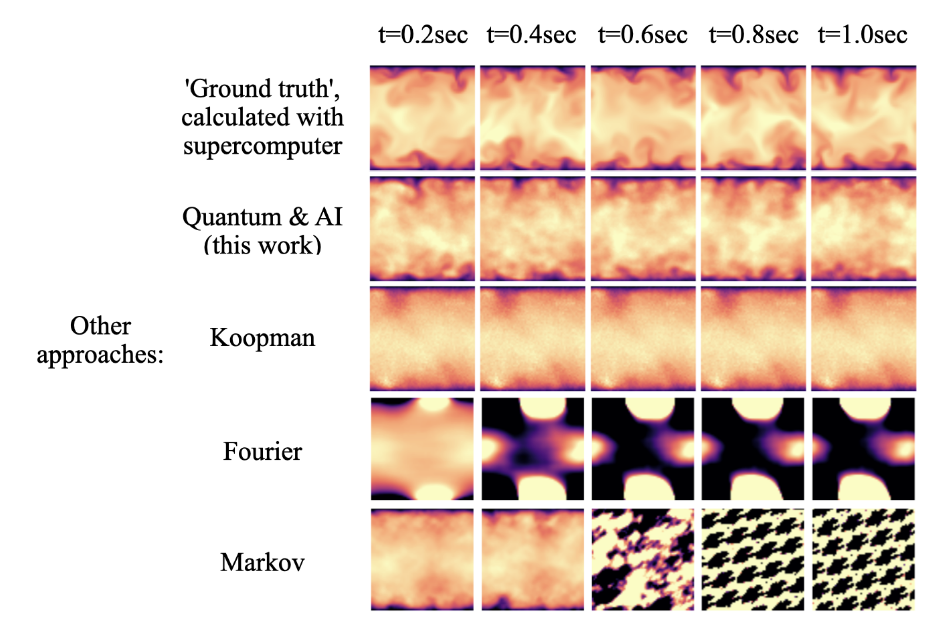
The improvement in the ability to model chaos is significant. On three well known (at least, to scientists) chaotic systems – with arcane names such as the Kuramoto-Sivashinsky equation, 2D Kolmogorov flow, and 3D turbulent channel flow – Quantum Informed Machine Learning boosted predictive accuracy by up to 17% and fidelity by up to 29% compared to classical AI.
More importantly, the Q-Prior trained on a real superconducting quantum processor was essential for predicting turbulence in a channel. Without it, predictions went physically unstable. With it, AI produced forecasts outperforming even the most advanced alternatives, as shown here:
Prof Coveney said that making AI consistent with physics matters for engineering, weather, and climate predictions and this work also passes a milestone, known as quantum advantage, where a quantum machine fundamentally outperforms what any classical computer can do. ‘Almost every previous claim of “quantum advantage” has faced scepticism, often rightly so, because many involved artificial problems that exaggerated performance,’ said Prof Coveney.
‘This result is different: turbulent flow is a real-world problem, important for aircraft design, weather prediction, and nuclear fusion. The quantum contribution is visible, measurable, and delivered on actual quantum hardware.’
Prof Coveney has maintained with me in the journal Frontiers of Physics that the usual question – ‘What can AI do for quantum computing?’ – is backwards. The UCL work suggests the more fruitful question is: ‘What can quantum computing do for AI?’ The answer: make it respect the laws of physics.
Quantum Meets the Molecule
The same hybrid quantum–classical strategy can also help tackle a very different challenge: how to simulate complex biological molecules. On 16 March 2026, at NVIDIA’s GTC conference in San Jose, UCL and European partners unveiled a way to simulate a biologically realistic molecule with quantum-level precision, revealing new details of how they work that could pave the way to novel drugs.
The target was a G-protein-coupled receptor (GPCR) — tiny molecular switches embedded in cell membranes that receive signals and trigger responses. There are over 800 subtypes that control heart function, brain signaling, hormones, and more in the human body. About one-third of all approved drugs act on GPCRs but these huge molecules, more than a million atoms, are hard to simulate and understand.
The new approach splits the problem across levels. Quantum computing handles the active site of the receptor - the electrons that buzz around the location on the GPCR where a drug attaches. This step ran on Euro-Q-Exa, a 54-qubit superconducting quantum processor at the Leibniz Supercomputing Center (LRZ) in Germany.
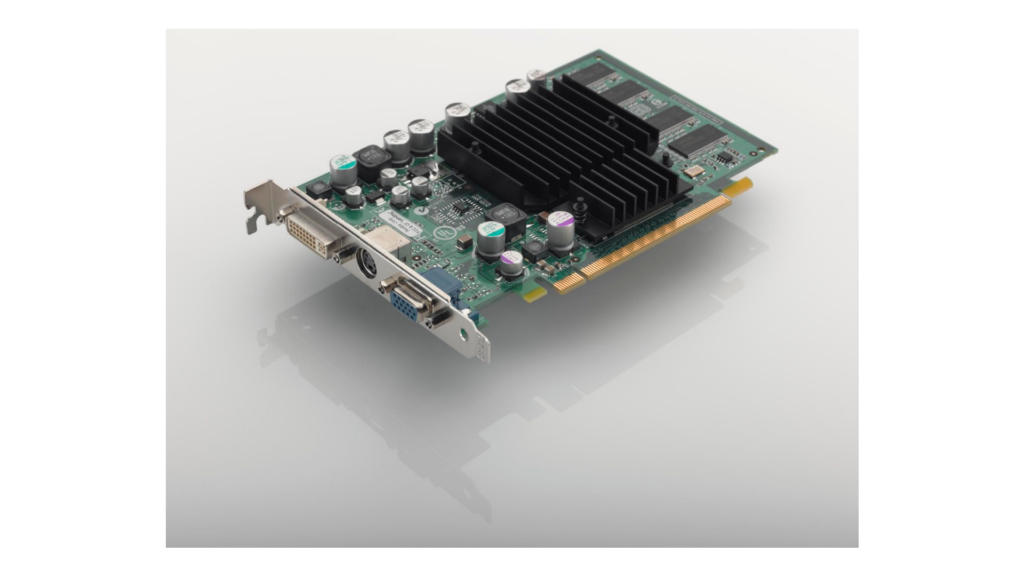
‘Classical simulations on a supercomputer, one that used processors called GPUs, then modelled the much larger numbers of atoms in the surrounding membrane and solvent,’ said Prof Coveney. ‘Quantum computers at their best can solve some problems more effectively than conventional computers; others are tackled more effectively by the latter.’
‘In molecular biology, we frequently encounter both at once, where we need to worry about the detailed structure and dynamics of a vast protein operating over milliseconds to hours, while the biochemical processes they catalyse can occur much faster and can only be described using quantum mechanics,’ he said. ‘Therefore, we need to bring both classical and quantum descriptions of matter into a single “multiscale” simulation of the processes which GPCRs carry out.’
Drugs usually work by blocking the active site where the quantum mechanics matters most, so this new approach can help work out what are called ‘interaction potentials’, added Prof Coveney, helping to pave the way to develop new treatments.
The UK’s £2 Billion Bet on Quantum Technology
Governments are investing heavily in quantum computing, even though the technology is experimental and nobody has yet settled on the best fundamental design. The UCL results coincided with the UK government’s most ambitious commitment to the field yet: on 17 March 2026, a £2 billion package to make the UK a global leader in quantum computing, sensing, and networking.
Prof John Morton, Director of the UCL Quantum Science and Technology Institute, UCL, and also principal investigator of a hub that brings together expertise in quantum technologies and biomedicine from across six universities, described the initiative as ‘a leap in ambition to unlock the potential economic and societal impacts of quantum technology.’