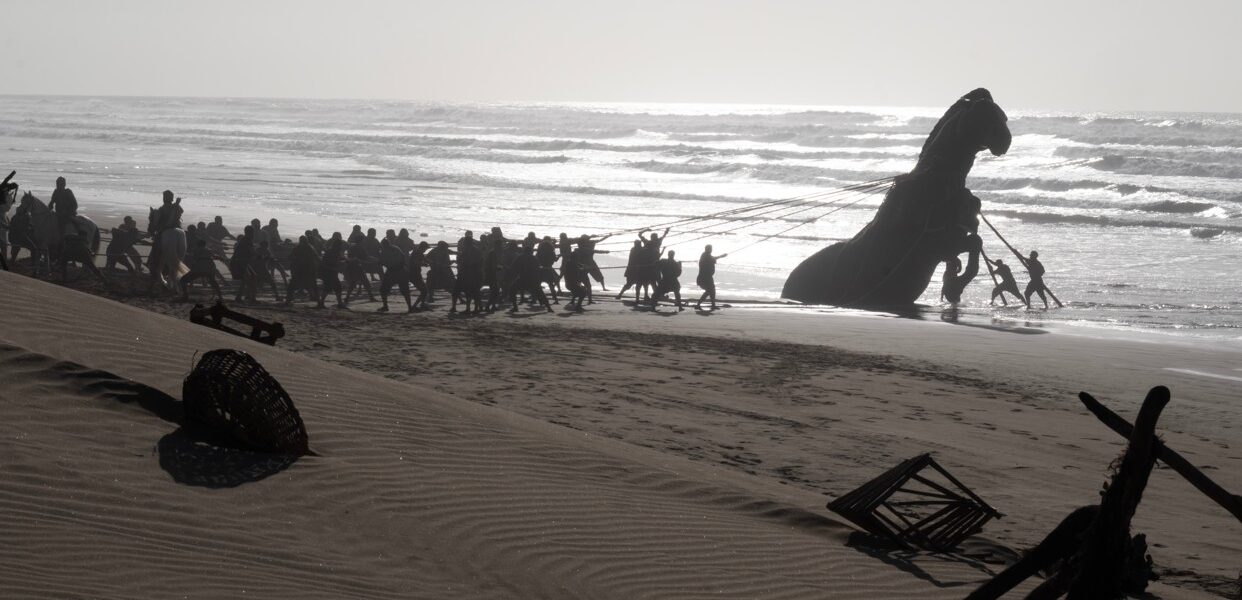
With The Odyssey now showing at IMAX: The Ronson Theatre in the Science Museum in London. This self-guided tour invites you to discover six fascinating objects that each tell a story of an extraordinary journey.
Stop 1: Model of the SS Oceanic – Making the Modern World gallery (Level 0)
After entering the museum, head towards the Making the Modern World gallery, walking straight ahead through the Energy Hall, through the long corridor, and past the bank of lifts (Lift D). Once you’ve entered the gallery take a right just before you reach the large lighthouse glass on the right-hand side of the gallery. You will see a glass case containing a large model of a ship.
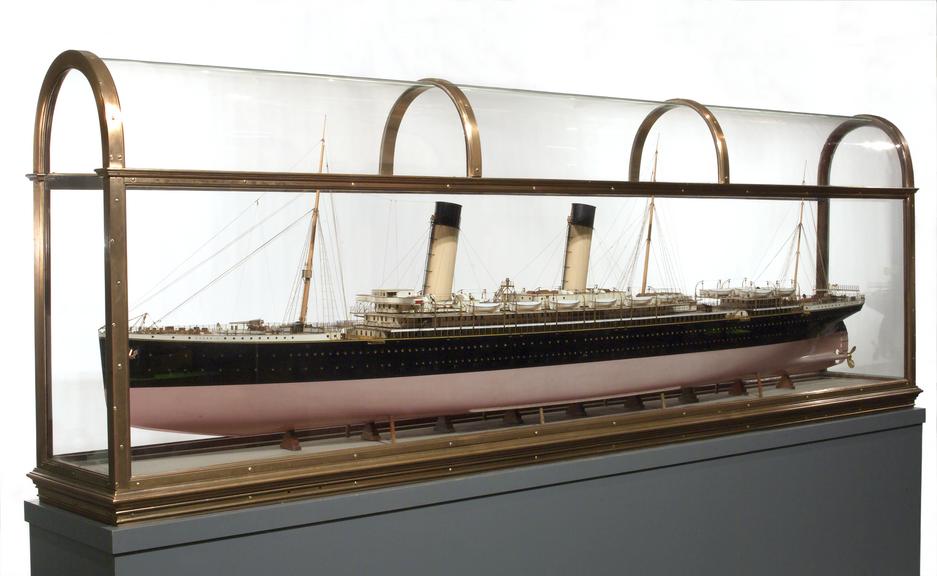
This is a 1:64 scale model of the SS Oceanic, the last British transatlantic liner to be launched in the nineteenth century. Built for the White Star Line, perhaps most famous as the operators of Titanic, it was 704 feet long and cost almost £1 million. It was the largest ship in the world when it launched in 1899.
This model was built to sit in the liner’s company offices, something which was regularly done at this time. When launched, the SS Oceanic was a real showpiece for British engineering, as well as a symbol of national prowess. The ship had 26,000 horsepower, generated by steam engines, and was built to naval specifications so that the British Admiralty could convert it for military purposes if war broke out.
First class passengers would have enjoyed real luxury on this liner, with lavishly decorated interiors. When Oceanic was launched, emigration from Europe to America was in full swing, the majority of which were third class passengers. By 1910 immigrants were arriving to the US at a rate of about a million a year. In fact, the Oceanic carried 1,000 third class passengers every fortnight.
The Oceanic remained the flagship of White Star until the advent of the Olympic and Titanic in 1911 and 1912. When the First World War broke out, Oceanic was one of the first ships requisitioned for service.
Sadly, Oceanic ran aground in the Shetlands in 1914 and was declared a total loss. However, in its heyday it transported thousands of passengers on their own epic journeys to a new life on the other side of the Atlantic.
Stop 2: London Ambulance Cycle Response Unit bicycle – Medicine: The Wellcome Galleries (Level 1)
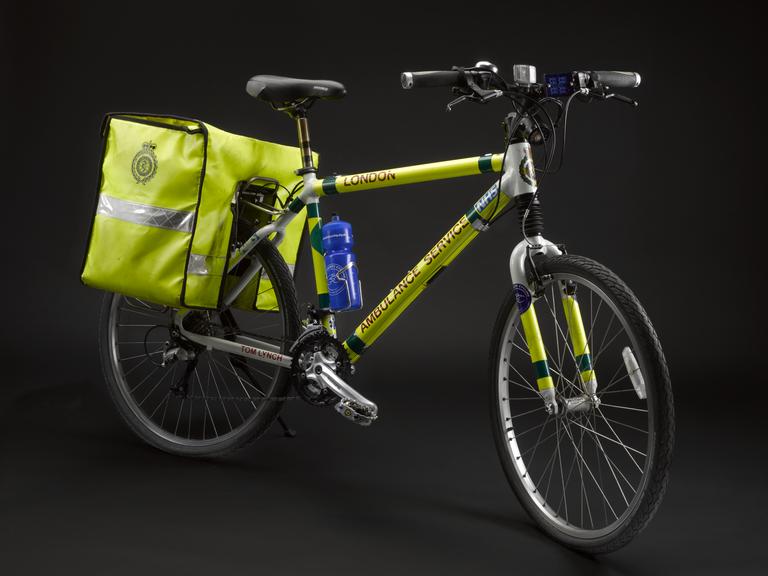
Head back out of the gallery the way you came in. When you reach Lift D, take the lift up to Level 1. You are now in Medicine: The Wellcome Galleries. Walk around the bank of lifts until you are on the opposite side. In the cabinet in front of you, you will see a bicycle with ‘London Ambulance Service’ written on it.
Not every epic journey has to cover continents. Sometimes, it’s about getting across an urban environment faster than anyone else when it matters most.
This customised Cannondale bike was used in the early development of the London Ambulance Cycle Response Unit. It was created by BMX champion turned emergency medical technician Tom Lynch MBE, who believed he could reach patients faster by bike than by ambulance in congested parts of London.
Fully loaded with medical kit and weighing almost 27 kilograms, the bike did indeed prove faster than an ambulance in built-up areas. In fact, during a six-month trial period in 2000, the cycle team freed up over 250 hours for other ambulances by getting to patients quickly.
Today, cycle responders attend nearly 17,000 calls a year and their average response time to calls is six minutes – proving that not all epic journeys have to be long ones!
Stop 3: Henry Sutton’s magnetic compass and sundial – Science City 1550-1800: The Linbury Gallery (Level 2)
Take a right and walk through the Medicine and Bodies section of the gallery, past the large bronze sculpture of a man holding a medical anatomy book until you reach Lift C on the other side of the gallery. Head up to Level 2. Turn right to enter Science City 1550-1800: The Linbury Gallery. After entering the gallery, follow the walkway around to the left-hand side. You will see a large portrait of Sir Isaac Newton; next to it is a cabinet labelled ‘Science, commerce and the city’. Inside, you’ll find objects made by London instrument maker Henry Sutton.
Long before satellite navigation, a journey could depend on a small instrument in your pocket, and sometimes a chunk of stone.
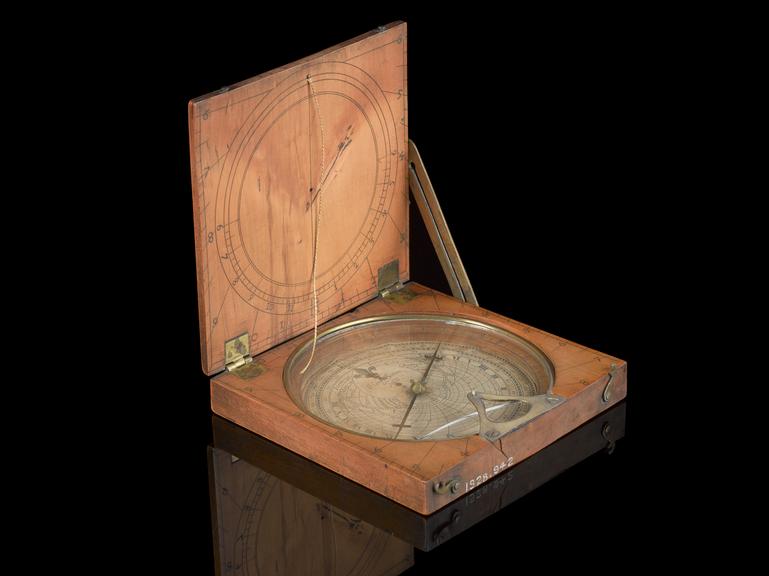
Henry Sutton made this clever pocket compass and sundial in 17th-century London, between 1650 and 1665. Designed to be small enough to carry anywhere, instruments like these were useful for navigation, helping travellers find their way and tell the time.
Henry Sutton was a leading mathematical instrument maker in London at the time. He died in the plague of 1665 and his loss was much lamented by the Royal Society.8 If you look very closely at the centre of the compass, you will see ‘Henry Sutton fecit’ engraved into it, ‘fecit’ being the Latin term for ‘made this’.
Next to the compass sits a lodestone, which is a piece of magnetite – a magnetic iron ore. ‘Lode’ is Old English for ‘path’ or ‘course’, which shows how they were used; when a compass needle needed to be remagnetised, the lodestone would be ‘touched’ to it, so that it kept pointing a true course.
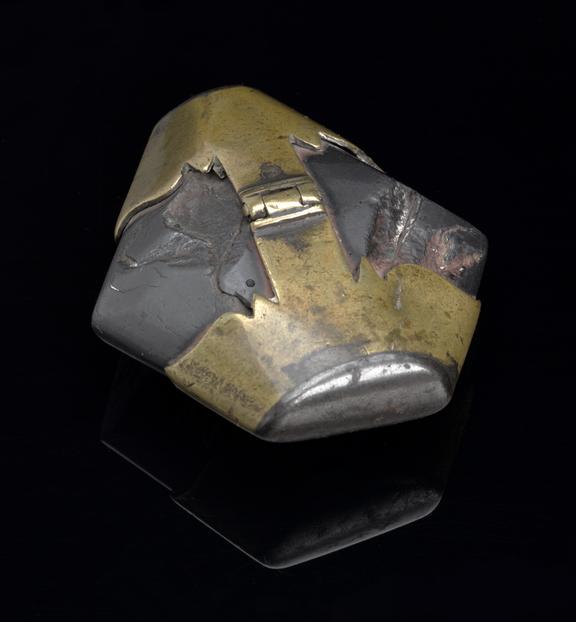
Instruments like these enabled London to grow from a lively capital city to a global hub for trade, commerce, and scientific enquiry between 1550 and 1800, a theme explored throughout the gallery.
Stop 4: Smiths De Luxe wristwatch worn by Sir Edmund Hillary – Clockmakers’ Museum gallery (Level 2)
Now head over to the other side of the mezzanine to find the Clockmakers’ Museum. Look out for the second freestanding glass cabinet on your right, labelled ‘XX: London clockmaking in the 20th century.’ You will find a wristwatch worn by Sir Edmund Hillary, in front of a photograph of him during his Mount Everest summit climb.

Before you is a simple-looking wristwatch with a huge history. Sir Edmund Hillary wore this Smiths De Luxe when he and Tenzing Norgay became the first people to reach Everest’s summit in 1953.
Made by Smiths English Clocks Ltd in Cheltenham, the watch had a steel waterproof case, luminous numerals and a movement prepared with special lubricant so it could withstand freezing temperatures.
Hillary and Tenzing Norgay’s climb was one of the defining journeys of the twentieth century. Supported by a wider expedition team that included 350 porters, 20 Sherpas, eight other climbers and tons of supplies, Hillary and Tenzig reached the 29,000-foot summit of Everest at 11.30am on 29 May 1953, becoming the first known people to stand on the highest mountain on Earth.
The magnitude of the 1953 climb should not be underestimated. Faced with severe lack of oxygen at high altitudes, hurricane-force winds, and temperatures as low as -34 °C, this small watch represents one of the most difficult journeys in human history, as well as a momentous achievement.
Stop 5: Amy Johnson’s Jason I – Flight gallery (Level 3)
Head back out of the gallery the way you came in, walk past Lift C and wander through Mathematics: The Winton Gallery. On the other side of the gallery you will find Lift D. Go up to Level 3. Turn left and enter the Flight gallery. Walk into the centre of the gallery and look up, you will see a green Gipsy Moth aeroplane with silver wings, with G-AAAH written across it.
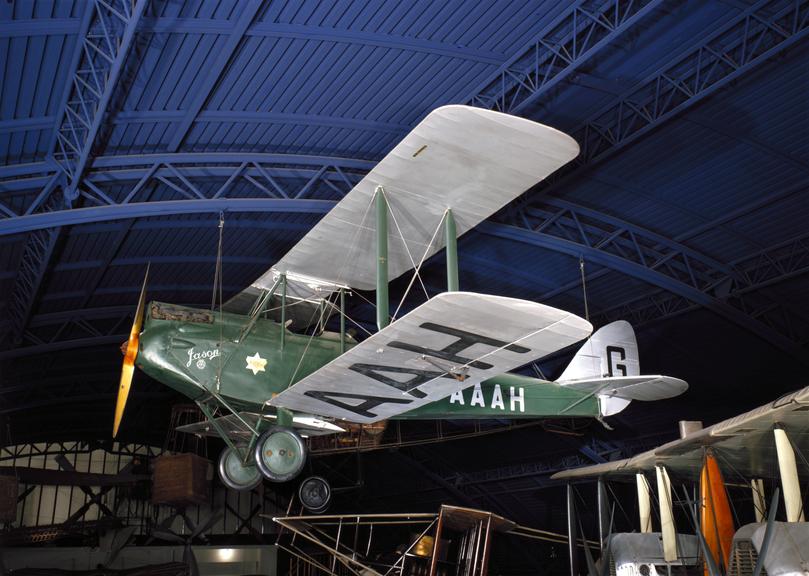
The Gipsy Moth aeroplane was made during a boom in private aviation between the First and Second World Wars, with about 1,000 built by the de Havilland company at Edgware, Greater London.
This particular one is called Jason I and was flown solo by Amy Johnson from Great Britain to Australia in 1930.Costing £700, Johnson’s Gipsy Moth was a standard civil aircraft, simply fitted with extra fuel tanks for longer-distance flying.
At the time of the flight, Johnson had completed only one hundred hours of solo flying and the farthest she had previously flown was from London to Kingston upon Hull.19 Her journey from Croydon to Darwin covered around 18,000 kilometres, taking her over deserts, through monsoon weather, and across long stretches where finding a safe place to land was far from guaranteed. She arrived at Port Darwin, Australia, 19 days and a half days after take-off, making headlines around the world.
Despite the achievement, as a woman, Johnson was still barred from the RAF during the Second World War. Instead, she joined the Air Transport Auxiliary, ferrying RAF aircraft to different locations throughout the UK. Sadly, she died after bailing out of her aircraft over the Thames Estuary in 1941. Her body was never found.
In an age when aviation was still new, risky and often dominated by men, Amy Johnson’s flight made her an international celebrity and helped change ideas about who could take to the skies.
Stop 6: BepiColombo Structural Thermal Model – Space gallery (Level 0)
Keep walking through the Flight gallery, until you come out the other side and reach Lift F. Take the lift down to Level 0. You are now in the Space gallery. Walk past the Space shop to the back of the gallery and you will come across the huge full-size model of BepiColombo.
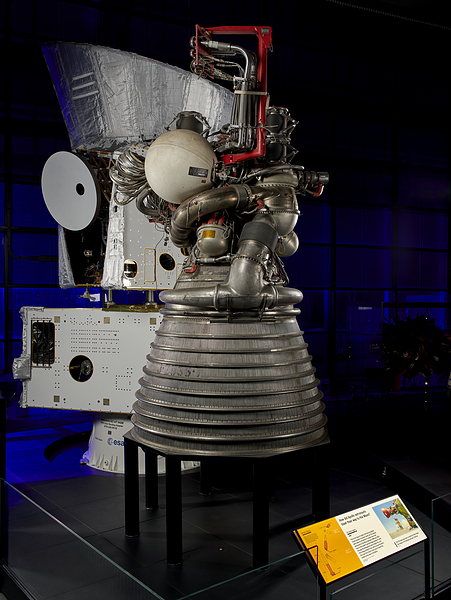
Standing before you is a full-size engineering model of the BepiColombo spacecraft, a joint mission to Mercury between the European Space Agency and the Japanese Aerospace Exploration Agency.
Built by Airbus, this model went through intense testing to check that the flight model could survive both the launch and journey to Mercury. On its sun-facing side, Mercury’s surface temperatures reach 400˚C, but also dip to -190˚C on the night side. The model was tested in these temperatures to ensure it could withstand these extremes. It is therefore not surprising that the silvery insulation blanket is made up of 97 layers of aluminium, plastic and glass ceramic fabrics.
BepiColombo is made up of two spacecraft which will study all aspects of Mercury, from how its magnetic field interacts with the solar wind, to the geological makeup of its surface. The data will improve not only our understanding of the planet, but also the formation of the Solar System.
Getting to Mercury isn’t easy; BepiColombo launched in October 2018 and has been winding its way through the inner Solar System ever since, using flybys of Earth, Venus, and Mercury itself for gravity assists. Gravity assists use the gravitation pull of the planet to adjust both the spacecraft’s trajectory and speed which means the spacecraft can carry less fuel. But this also means the journey takes much longer – 8 years in fact. The spacecraft will arrive at Mercury in November this year.
That concludes our tour through the six incredible objects that represent epic journeys. To continue your own journey, head to the IMAX: The Ronson Theatre ticket office in the Space gallery and check out Christopher Nolan’s The Odyssey in IMAX.