Each object tells a story about innovation and human ingenuity. By choosing to adopt, you’re helping to preserve the Science Museum Group’s incredible collection, so that it can be enjoyed for generations to come.
Adoptions start from £3 a month for one year and as a thank you adopters receive a digital adoption certificate, a personalised thank you email from the Head of Collections, and tailored twice-yearly email updates from the museum.
Stop 1: Making the Modern World, Ground floor – The Rover ‘Safety’ Bicycle from 1885
Start your tour by heading to the Making the Modern World gallery on the ground floor. As you walk through, look out for the large black locomotive on your left – the ‘Grand Junction Railway Locomotive Columbine’ (1845). Once there, look up to your left – hanging from the ceiling is the Rover ‘Safety’ Bicycle.
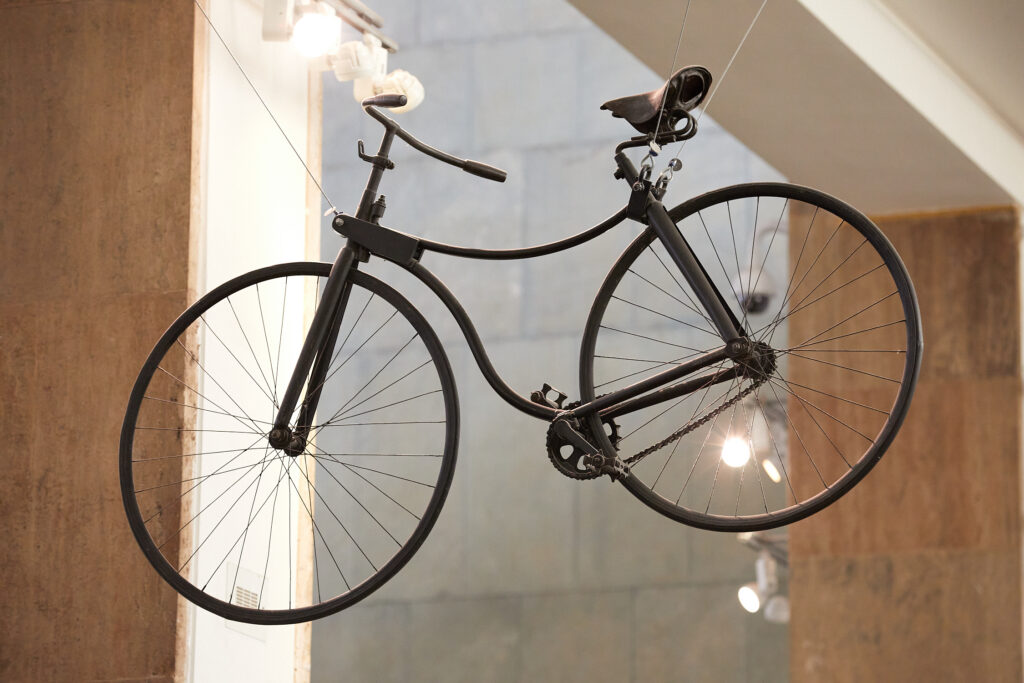
At first glance, this unassuming bicycle is easy to overlook, however, it played a vital role in the social, cultural and political change of the late nineteenth and early twentieth centuries.
It was designed as a safer and more stable alternative to the earlier penny-farthing – examples of which can be seen in a case on the right-hand side of the gallery. The penny-farthing’s large front wheel made mounting the bicycle more difficult, and it was almost impossible to rest your leg once you stopped.
In contrast, the ‘Safety’ bicycle used a diamond shaped frame and chain drive which meant that both wheels could be the same size, and the rider could be closer to the ground. This made cycling easier, including for women in skirts, who took the opportunity to partake in unaccompanied travel (although it was largely only middle- and upper-class women who could afford a bicycle).
By the 1890s, women were increasingly visible in the bicycle boom in the US and Britain. The bicycle, and the independence it symbolised, became closely associated with the idea of the ‘New Woman’ – a figure linked with education, greater economic freedom, and participation in sport.
Prominent American activist in the woman’s suffrage movement Susan B. Anthony said in 1896: “I think the bicycle has done more to emancipate women than any one thing in the world. I rejoice every time I see a woman ride on a bike. It gives her a feeling of self-reliance and independence the moment she takers her seat, and away she goes, the picture of untrammelled womanhood”.
Stop 2: Making the Modern World, Ground floor – Teddy bear
Now turn to your right and look out for the large lighthouse lamp (Eilean Glas). In the glass cabinet behind it, you will spot a teddy bear placed alongside a wax doll from 1890.
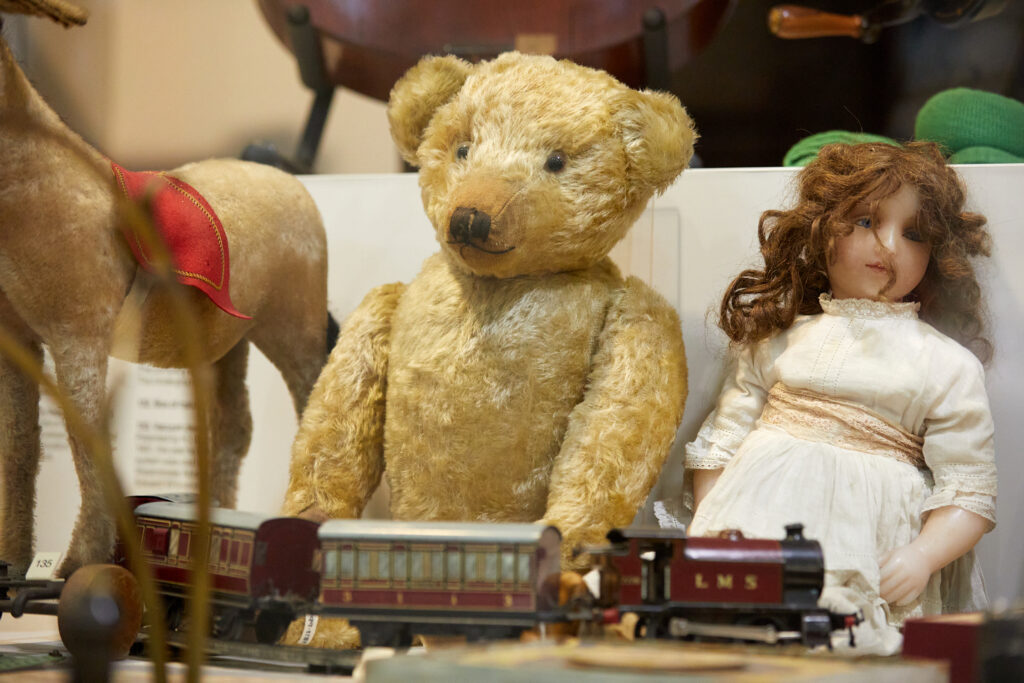
This English golden mohair teddy bear is around 100 years old, dating back to the 1920s, when the idea of the ‘teddy bear’ was still relatively new.
Soaring to popularity in the early twentieth century, the ‘teddy bear’ was named after American President Theodore Roosevelt. The origins of the term lie in 1902, when a Washington Post cartoon depicting the President refusing to shoot a bear during a hunting trip was published. This inspired American sweet-shop owner Morris Michtom to ask his wife to create a stuffed bear named in Theodore’s honour, ‘Teddy’.
At around the same time in Germany, the Steiff children’s toy company also began making bear toys. The founder of the company, Margarette Steiff, had been making stuffed animal toys since 1880, but it wasn’t until 1902 that a bear similar to the one on display was created by her nephew, Richard Steiff.
The Steiff Bears proved extremely popular, and in 1906 the company also officially began using the term ‘Teddy Bear’, a phrase that has stuck to this day. In 1907 alone, Steiff produced 973,999 teddy bears with just 400 employees and 1,800 home workers.
The continued popularity of the teddy bear has made it a symbol of childhood itself, and a reminder that despite the wealth of change that the world has experienced over the last century, there remain some core experiences, such as owning your first teddy bear, that unite us across the decades.
Stop 3: Making the Modern World, Ground floor – The Optimus Toilet from 1870
Walk back toward the gallery entrance, following along the wall, and you will encounter another glass cabinet containing the ‘Optimus’ water closet. It is on the third tier inside the case, opposite the large wooden model of a Paddle Engine of the Great Eastern (1853-1857).
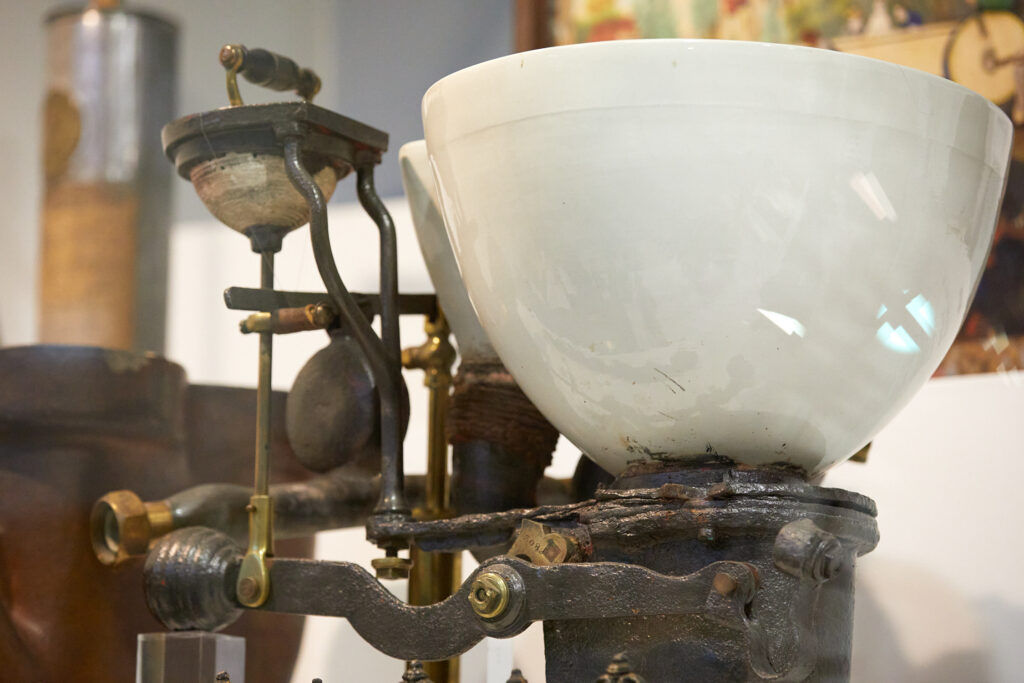
This model of an ‘Optimus’ water closet represents one of many Victorian-era attempts to improve household sanitation. It is made from ceramic, rather than earlier wooden examples, and features a quieter and more efficient working flush. This is one example of how nineteenth-century innovators were making improvements to improve people’s day-to-day lives.
The 1800s marked a key turning point in the history of sanitation. In the first half of the century, in cities like London, up to a hundred people might share just one toilet. This meant that sewage frequently overflowed onto streets and into rivers, eventually contaminating drinking water supplies. The result was major cholera outbreaks in the 1830s and 1850s, which caused the deaths of thousands of people.
In response, the government’s 1848 Public Health Act required every new house to include some form of sanitation facilities, such as an ash-pit privy, a type of toilet system where waste was emptied by workers known as ‘night-soil men’.
But it wasn’t until 1858, after a particularly hot summer caused the ‘Great Stink’, that the government was forced to fund a more modern sewer system for London, which was completed in 1865.
It is against this backdrop of societal change that manufacturers began introducing more advanced and hygienic toilet designs like the ‘Optimus’ water closet. Thanks to innovations like these, deaths from cholera, typhoid, and other waterborne diseases began to decline in the UK.
Stop 4: Medicine: THE WELLCOME GALLERIES, Level 1 – Penicillium Mould from 1935
Leave the gallery the way you came in and take Lift D to Level 1. Turn right into the Medicine gallery. Walk down the left-hand side of the gallery towards the ‘Gibson and Sons’ pharmacy installation at the end. Stop when you reach the Penicillin glass cabinet on your left – this is the sixth cabinet along from where you entered the galley. Here you will find Alexander Fleming’s sample of Penicillium mould.
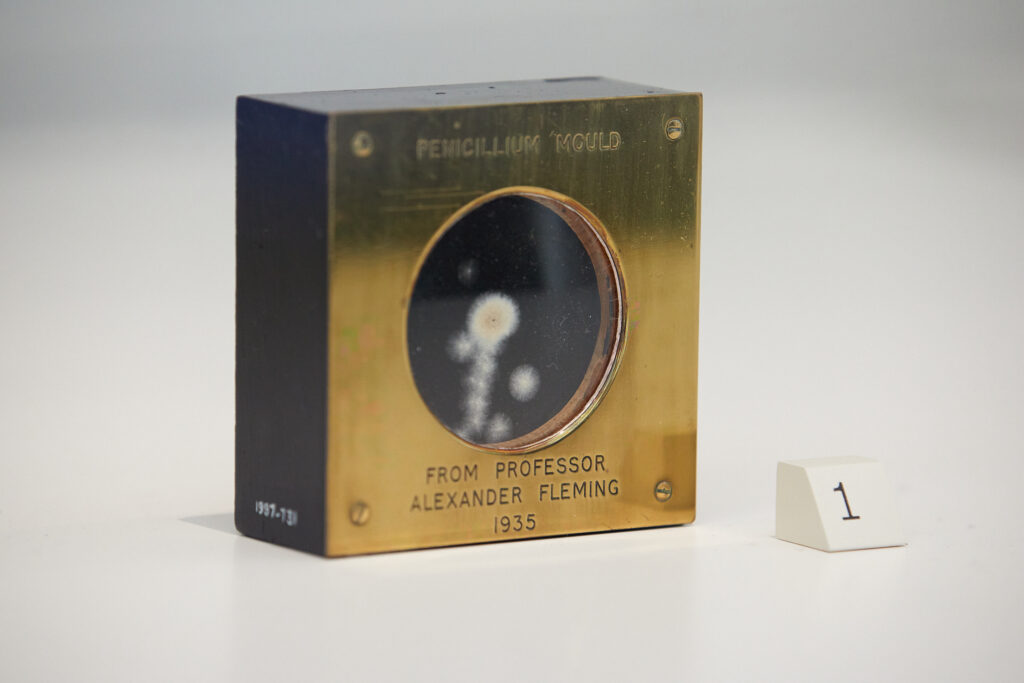
This sample was presented by Alexander Fleming to a colleague at St Mary’s Hospital in 1935. Seven years earlier, Fleming discovered that this species of mould produces a substance he called ‘Penicillin’, which has powerful antibiotic properties. Before this discovery, even minor infections – from something as small as a paper cut – could be deadly due to bacterial infection.
Fleming’s discovery was accidental. After returning from a holiday, he found mould growing on a Petri dish of Staphylococcus bacteria. He observed that the mould produced a self-defence chemical that seemed to prevent the bacteria from growing around it. Despite early excitement at this finding, Fleming was unable to purify penicillin from the mould and eventually abandoned his work.
Several years later, in 1937, Howard Florey and Ernst Chain uncovered Fleming’s research and enlisted a team of scientists to work solely on the ‘Penicillin Project’. They were successful in producing pure penicillin, although the process was inefficient as gallons of mould broth was needed to produce just one fingernail of penicillin. Despite the slow progress, the scientists set up a penicillin factory in Oxford and employed six women, known as ‘Penicillin Girls’, who worked to ‘farm’ penicillin from the broth.
The first human trial of penicillin took place in 1941, when it was given to a policeman suffering from a life-threatening infection. Despite initial signs of improvement, the supply of penicillin ran out, and he died five days later when the infection returned.
Mass-production was clearly required for penicillin to be truly effective, but with the Second World War in progress, Britain did not have the resources. So, in 1941, Florey set up a new team at the Department of Agriculture in Illinois, USA. The team there improved the efficiency of growing penicillin and began to search for new strains of mould. Eventually, laboratory assistant Mary Hunt found a rotting cantaloupe at a local market, the mould from which produced six times more penicillin than Fleming’s original strain.
In just two years, the US had developed sufficient penicillin stocks to supply its armed forces and those of its allies. By 1946, penicillin became available to the UK public, transforming the world of medicine. However, the fight continues. Today, bacteria have evolved to become resistant to the original penicillin, meaning that new antibiotics must be developed.
Stop 5: Information Age Gallery, Level 2 – Antenna Disguised as a Cactus from 2014
Return to the staircase (Staircase D) or lift (Lift D) and go to Level 2. Turn right into the Information Age gallery, and turn right again, where standing tall near the entrance you will see the antenna disguised as a Saguaro Cactus.
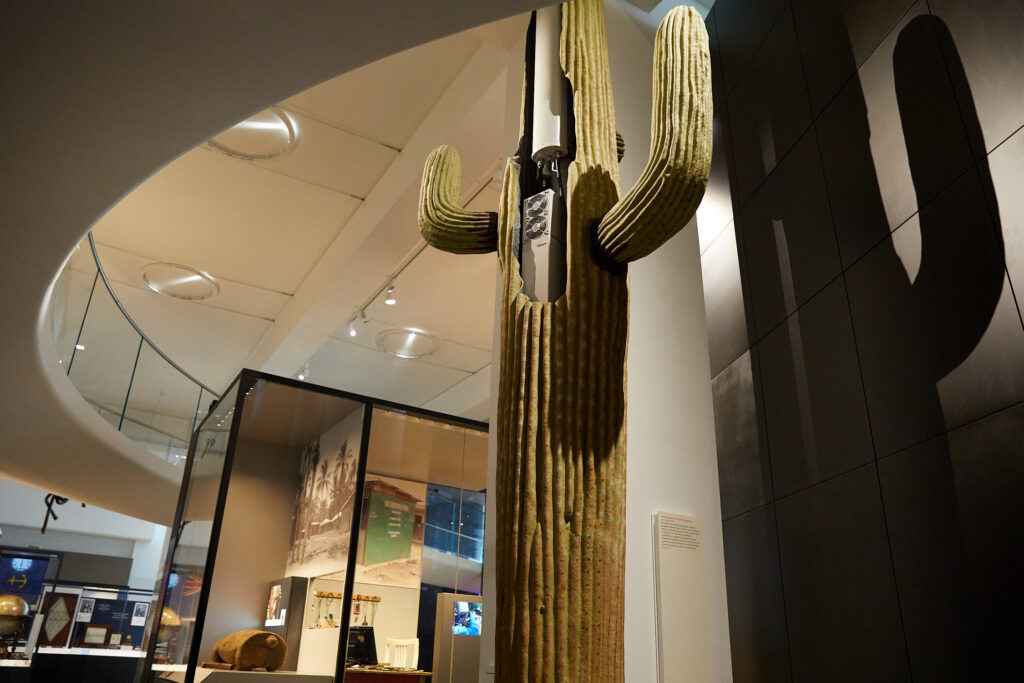
This mobile phone base station antenna is disguised as a Saguaro cactus. In rural areas, antennas had to be particularly large as they often served greater distances. The arrival of antennas was sometimes accompanied by anger, as people saw them as an eyesore. In response, companies such as Larson Camouflage, who built this antenna, began designing aerials that fit in with their landscape.
This cactus is designed specifically for desert environments. It conceals three antennas as well as radio equipment, and features simulated wounds, scars and woodpecker holes, as would be found on a real cactus in the desert.
It isn’t just in cacti that you might find antenna. In Marrakech, Morocco, antennas can be found disguised as palm trees, whilst in the American Midwest they are built into fake water towers.
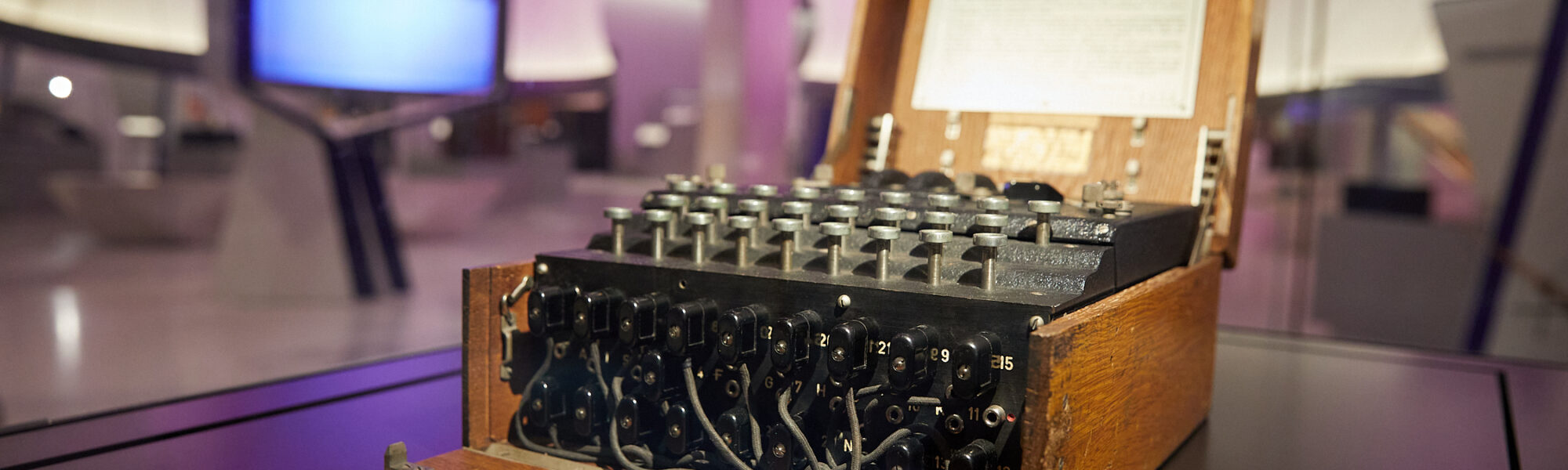
Stop 6: Mathematics Gallery, Level 2 – Enigma Cypher Machine from 1934
Walk back the way you came, past Lift D, and into the Mathematics gallery. Walk along the left-hand route of the gallery until you find the Enigma Machine. There is also a touchscreen next to it where you can learn more.
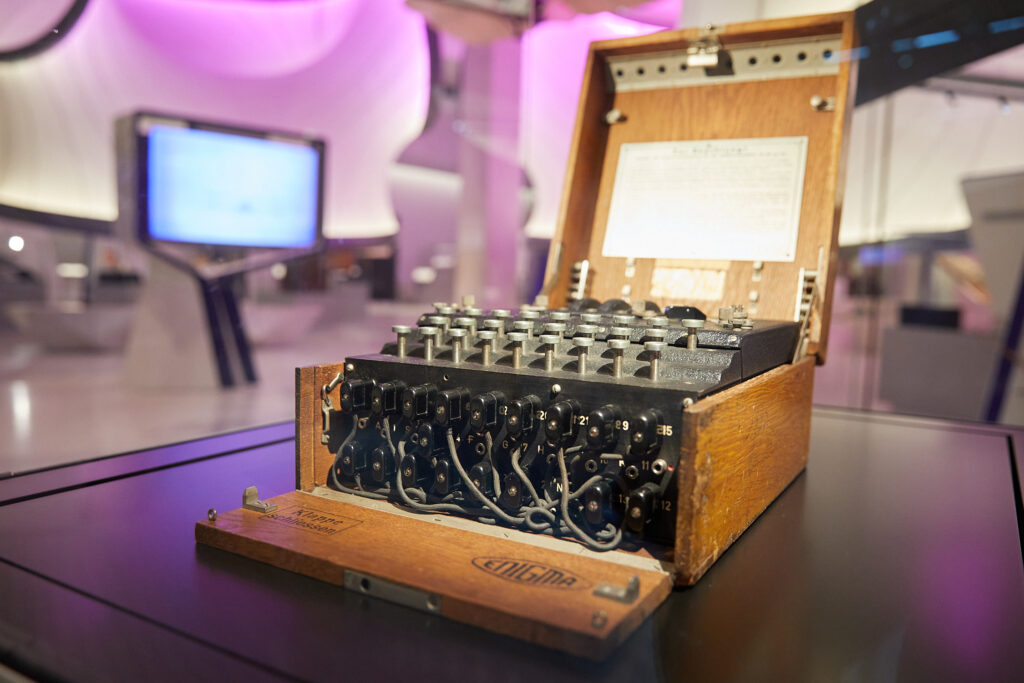
This is an early example of an Enigma machine. Senders typed their messages on the keyboard, and each typed letter was encrypted by passing an electrical signal through a plug-board and rotors, causing a different letter to light up. These new letters formed a secure message, which could be transmitted by radio to the recipient. At the receiving end, the message was decrypted using another Enigma machine.
Enigma machines were first introduced in the 1920s for keeping commercial messages secret, but were then adapted for military use. Throughout the Second World War, Germany and its allies encrypted military messages using Enigma machines, and by 1945, over 40,000 such machines were in use.
The Germans considered the Enigma code to be unbreakable and used it for their most top-secret messages. But the codebreakers at Bletchley Park in Buckinghamshire, the British army’s intelligence centre, managed to decipher the code.
Key to this breakthrough was Alan Turing, who joined Bletchley Park in September 1939. Building on the work of Polish specialists, Turing developed sophisticated decryption processes. With colleague Gordon Welchman he devised machines called ‘bombes’ that could break the code on an industrial scale. Some 200 bombes were built at a secret facility nearby, operating around the clock at several sites. The intelligence gained from the deciphered Enigma messages was vital to Britain’s success in the war.
However, Turing’s legacy extends beyond his work at Bletchley Park. In 1936 he wrote a mathematics paper that has come to be seen as the theoretical basis for today’s computers: the idea of a single, universal machine that could compute any problem. By the 1950s, Turing’s idea had become a reality, with computers installed in large institutions, companies and universities. Once filling entire rooms, computers have been transformed by advances in science and technology into smartphones we can now carry in our pockets.
That concludes our tour through the six incredible objects available for adoption. Interested in adopting one yourself, or as a gift? Find out more about the museum’s Adopt an Object initiative.