
Around 3,500 miles away, in Baikonur, Kazakhstan, ESA astronaut Tim Peake, NASA astronaut Tim Kopra and their commander, Russian cosmonaut Yuri Malenchenko, were squeezed inside their tiny Soyuz capsule, readying themselves for launch and the start of their 6-month mission to the International Space Station.
As the countdown began, the anticipation inside the museum was electric. 10, 9, 8, 7, 5, 4, 3, 2, 1 … Lift-off! The crowd erupted in cheers, their Union Jack flags waving furiously. Legend has it that the roof of the museum lifted off its supports for just a moment as the celebrations echoed upwards.
I had the incredible privilege of being part of that event, a career highlight I’ll never forget. At the time, I was the UK Space Agency’s Education and Outreach Programme Manager for Tim’s Principia mission, working with over 30 fantastic partners, including the Science Museum, to deliver activities that connected young people to the mission and showcased the wonders and possibilities of the space sector.
Fast forward a decade, and to my absolute delight, I’m now part of the Science Museum team, in my role as Head of Space. We’re thrilled to work with Tim to celebrate the 10th anniversary of his mission, reflect on its legacy, and inspire even more people with the excitement of space. Tim always joked that he missed the party when he went to space, but today he was here to join us for a lesson broadcast live from the museum to thousands of school children across the country.
When the UK Space Agency launched the Principia education programme, it set clear goals: to encourage interest and uptake in STEM subjects and careers in the space sector, and to increase the public’s knowledge of the space sector and the benefits it brings.
The immediate impact and reach of the programme were evident. More than 30 million people engaged with the mission through events, TV programmes and other broadcasts. More than 2 million school children, across 1 in 3 schools, took part in over 30 different education projects that linked to the mission. Rocket Science was a mass experiment to see if exposure to space impacted how seeds would grow. Mission X and the Space to Earth Challenge encouraged physical activity. The Principia Space Diary project including literacy, art and creative thinking, whilst Into Film encouraged film making.
We hoped the programme would leave a lasting legacy, but measuring long-term impact is never easy. That’s why it’s so rewarding to see people returning to the museum a decade later, sharing stories of how Tim’s mission has shaped their lives, and continues to inspire people to learn more about science and technology.
This weekend Raspberry Pi ran coding workshops that introduced participants to one of Principia’s most innovative ideas: Astro Pi.
As we prepared the education programme back in 2015, many, including Tim, wanted to find a way for school children to design and run science experiments on the space station, but time constraints and logistics made it impossible. So, we flipped the idea: send a computer that schools had easy access to into space and let students write the code to control its actions. Astro Pi was born and 17,000 school children took part.
Ten years on, more than 164,000 young people across Europe have seen their programmes run in orbit. The original computers have been upgraded, and one of the first is now part of the collection and displayed in our Engineers gallery.
Some of those 17,000 were from a group from Cranmere Code Club, whose leader, Richard Hayler, had learned about the activity and decided to get involved, even though many of the children had only just started learning to code. Their “Crew Detector” programme was run on the ISS, and the group were at the museum on Tim’s launch day. That experience left a lasting mark, and now, a decade later, some of the students are studying software engineering at university. For Richard, it sparked a career change: he left the Foreign Office after 20 years to join Raspberry Pi, where he helped design the Mark II Astro Pi computers. This weekend, Richard was back at the museum running coding workshops.
A group of apprentices, who work at Airbus Defence and Space, the UK’s biggest satellite manufacturer and space operator, also joined us this weekend. The apprentices remember Tim’s mission and shared how it sparked inspiration for them.
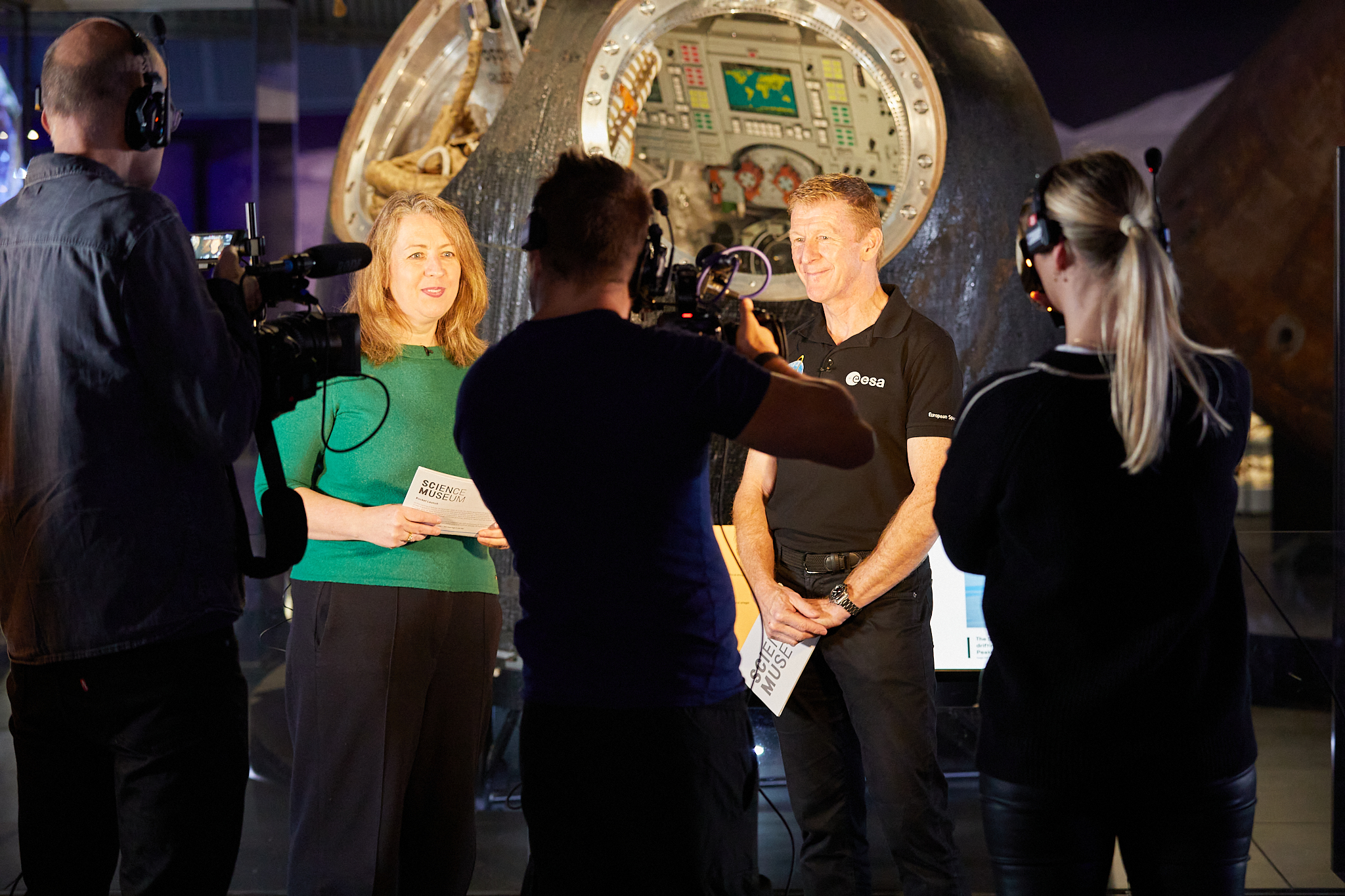
But perhaps the strongest reminder of the mission’s lasting impact came just last week, as Tim and I prepared for today’s live lesson. While we were discussing scripts and camera angles with the production team, we noticed a school group buzzing with excitement. Their teacher had spotted Tim and, thrilled, asked if she might introduce him to her class. As they said hello and posed for a photograph, she told us how she’d watched Tim’s landing and how much it the mission had meant to her. A decade after the mission, her enthusiasm for space was still strong and highly infectious. None of her students were born when Tim went into space and yet they were captivated by the excitement of space thanks to her passion for the subject.
Space, and the amazing science, technology and benefits that it brings to us all, has a huge capacity to inspire people. We see that every day in the Science Museum’s Space gallery, where the seeds of wonder are sown. Those planted during the Principia mission are now growing into saplings, and we’re proud to be celebrating this 10th anniversary of the mission, and continue the legacy. I look forward to seeing those saplings blossom further, in years to come, and in turn sparking more curiosity in science and technology.